
The multiple sclerosis (MS) experts advise health care providers on how to impact the early onset of disease progression and prevent neurodegeneration in patients with MS.
The multiple sclerosis (MS) experts advise health care providers on how to impact the early onset of disease progression and prevent neurodegeneration in patients with MS.
The neurologists discuss strategies to improve the cognitive health of patients with multiple sclerosis through physical and mental health multidisciplinary care.
The director of the headache section at Cleveland Clinic’s Neurological Institute provided commentary on the advances in the field of migraine and reasons to be excited about the 2023 AHS symposium in Scottsdale, Arizona. [WATCH TIME: 3 minutes]
The associate professor in the department of neurology and neurosurgery at McGill University discussed results from a study on the long-term use of continuous positive airway pressure treatment among patients with multiple sclerosis and sleep apnea presented at MSMilan 2023. [WATCH TIME: 5 minutes]
The physician neurologist and neuroimmunologist at Cedars Sinai Medical Center provided perspective on the patient-clinician relationships and the need to educate clinicians about the impacts of rare neuroimmune disorders in Spanish-speaking communities. [WATCH TIME: 3 minutes]
The neuromuscular neurologist at the Cleveland Clinic discussed findings from an analysis presented at AANEM 2023 that investigated the safety and efficacy of subcutaneous efgartigimod in patients with myasthenia gravis. [WATCH TIME: 5 minutes]
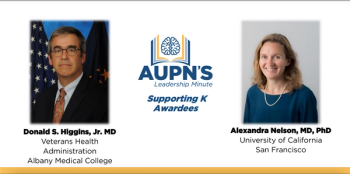
Episode 39 of the AUPN Leadership Minute features Donald S. Higgins Jr, MD, of Veterans Health Administration, Albany Medical College; and Alexandra Nelson, MD, PhD, of the University of California San Francisco. [WATCH TIME: 5 minutes]
The associate director of the Alzheimer’s Disease Research Unit at the Yale School of Medicine discussed the mechanism of action of ALX-001, a highly selective agent in development for neurodegenerative diseases. [WATCH TIME: 5 minutes]
The professor of neurology, psychiatry, and pharmacology at the NYU Grossman School of Medicine commented on the differences in mechanisms and clinical trial data between lecanemab and donanemab. [WATCH TIME: 5 minutes]
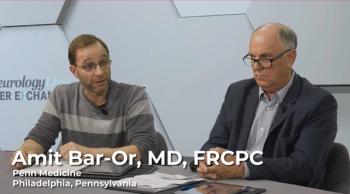
Amit Bar-Or, MD, FRCPC, summarizes fenebrutinib phase II results for the treatment of multiple sclerosis.
Patrick Vermersch, MD, PhD, summarizes phase II clinical trial of evobrutinib for the treatment of multiple sclerosis.
The founder of Strategic Advocacy Solutions LLC discussed the critical role of psychosocial support throughout various stages of neuromuscular diseases, emphasizing the impact of transitions on patients' emotional well-being. [WATCH TIME: 5 minutes]
Neurology News Network for the week ending November 11, 2023. [WATCH TIME: 3 minutes]
The director of the neuromuscular diseases division at the University of Washington discussed findings from a new post hoc analysis presented at AANEM 2023 that showed that zilucoplan treatment significantly reduced fatigue in patients with myasthenia gravis. [WATCH TIME: 6 minutes]
Dr Bruce Hughes and Dr Robert Naismith recommend assessments to aid physicians in evaluating and maintaining the cognitive health of patients with multiple sclerosis.
The MS experts share strategies to evaluate physical and cognitive disability progression and determine therapy changes in the clinical setting.
The radiation oncologist at Cooperman Barnabas Medical Center talked about how trigeminal neuralgia can be effectively treated with stereotactic radiosurgery using the CyberKnife offering pain relief without the need for invasive surgery. [WATCH TIME: 6 minutes]
The chief scientific officer at Athira Pharma talked about new preclinical results presented at the 2023 NEALS Annual Meeting on the investigational therapy ATH-1105 for patients with amyotrophic lateral sclerosis. [WATCH TIME: 5 minutes]
The vice president of Innovation and New Technologies at Grifols provided perspective on the interim phase 2 findings of ABvac40, a vaccine in development for patients with Alzheimer disease. [WATCH TIME: 3 minutes]
The vice president of translational medicine at Cene Nanomedicine talked about a recently funded grant that is focused on inclusivity and the collection of real-world data on the efficacy of CNM-Au8 in various stages of amyotrophic lateral sclerosis. [WATCH TIME: 7 minutes]
The professor and chair of neurology at Virginia Commonwealth University discussed a study conducted among neurologists that revealed healthcare disparities in the treatment of myasthenia gravis, particularly related to access to care and therapeutics. [WATCH TIME: 5 minutes]
The director of disability policy at the Muscular Dystrophy Association discussed his lecture at AANEM 2023 on how clinicians can advocate for their patients to help improve accessibility and health equity. [WATCH TIME: 7 minutes]
Patrick Vermersch, MD, PhD, and Krzysztof Selmaj, MD, PhD, provide an overview of the BTKi that are currently under investigation for MS, and Gavin Giovannoni, MBBCh, PhD, FCP, FRCP, FRCPath, discusses what in vivo and in vitro preclinical work in models of MS have shown.
Amit Bar-Or, MD, FRCPC, provides an overview of the history of BTKi’s as well as what makes this class of drug a promising target for relapsing and remitting forms of MS.
The assistant professor at Virginia Commonwealth University provided comment on her presentation from AANEM 2023, and the need to raise awareness towards nonneuromuscular symptoms of Duchenne muscular dystrophy. [WATCH TIME: 4 minutes]
The clinical research director of the UCSF Multiple Sclerosis Center talked about challenges in accessibility for the 3 approved therapies for NMOSD caused by third-party payor resistance as well as the importance of educating clinicians about the effectiveness of inebilizumab. [WATCH TIME: 3 minutes]
Neurology News Network for the week ending November 4, 2023. [WATCH TIME: 3 minutes]
The professor of neurology at Cedars-Sinai Medical Center talked about findings from the ADHERE trial assessing efgartigimod, a human IgG1 antibody Fc fragment, as a treatment for patients with chronic inflammatory demyelinating polyneuropathy. [WATCH TIME: 6 minutes]
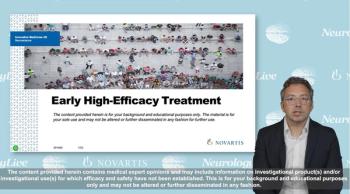
James Stankiewicz, MD, provides an overview of the burden of multiple sclerosis and discusses early, high-efficacy treatment of the disease.
The division director of Neuromuscular Medicine & EMG at USF Health provided an overview of the open-label findings from ADAPT-SC, a phase 3 study assessing subcutaneous efgartigimod in patients with myasthenia gravis. [WATCH TIME: 3 minutes]