
The neurologist at Allegheny Health Network’s Neuroscience Institute provided insight on the mechanism of action of fenebrutinib and how it differs from other BTK inhibitors currently in development. [WATCH TIME: 3 minutes]
The neurologist at Allegheny Health Network’s Neuroscience Institute provided insight on the mechanism of action of fenebrutinib and how it differs from other BTK inhibitors currently in development. [WATCH TIME: 3 minutes]
The director of the Center for Brain Health and Alzheimer prevention clinic at FAU medicine provides commentary about his time at the fourth annual International Congress on the Future of Neurology. [WATCH TIME: 4 minutes]
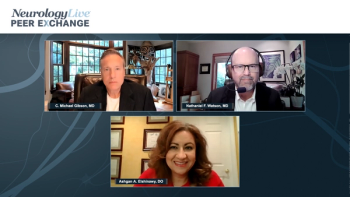
Nathaniel F. Watson, MD, reviews the pathways involved in sleep and wakefulness cycles as it relates to sleep disorders.
Dr Ashgan A. Elshinawy and C. Michael Gibson considers safety and efficacy factors when approaching treatment selection for sleep disorders and insomnia.
The director of NYU Langone’s Alzheimer’s Disease Research Center discussed noticeable advancements within the field of Alzheimer disease in recent years and how they contribute to gaining a better understanding of the disease. [WATCH TIME: 5 minutes]
The director of the Center for Brain Health and Alzheimer prevention clinic at FAU medicine shares his experience at the fourth annual International Congress on the Future of Neurology. [WATCH TIME: 3 minutes]
The assistant professor of neurology at Cleveland Clinic provided insight on the differences in ganglioside vs paranodal antibodies and their clinical use in various neuropathies. [WATCH TIME: 3 minutes]
Ashgan A. Elshinawy, DO, comments on engaging patients in conversations around managing sleep disorders with co-occurring health conditions.
Experts in sleep medicine stress the importance of early diagnosis of sleep disorders and how they approach treatment in their clinics.
The Zimmermann Professor of Neurology and Neurological Sciences and Pediatrics at Stanford University discusses what Amylyx’s FDA approved therapy means for the patient community and future research that may be performed regarding the dosage of the treatment. [WATCH TIME: 5 minutes]
The professor of Neurology and Pediatrics at University of Rochester Medical Center speaks spoke on the evolving treatments for Duchenne muscular dystrophy and the possibility of earlier diagnosis through newborn screening. [WATCH TIME: 4 minutes]
Neurology News Network for the week ending October 15, 2022. [WATCH TIME: 3 minutes]
Dr Nathaniel F. Watson reviews screening patients for sleep disorders and referral to sleep specialists.
Nathaniel F. Watson, MD; Ashgan A. Elshinawy, DO; and C. Michael Gibson, MD, examine complications patients encounter with sleep disorders, including for insomnia, and the impact on their quality of life.
Mitzi Williams, MD; Mirla Avila, MD; and Michael Levy, MD, PhD, highlight gaps in care in NMOSD therapy.
Drs Mirla Avila, Mitzi Williams, Michael Levy, and Michael Yeaman provide insight on goals of therapy and the importance of mental health and symptom management for patient populations with NMOSD.
The associate professor at the University of Michigan described the ways recently published guidelines on diabetic neuropathies will change how conditions like Guillain-Barré syndrome and CIDP are managed. [WATCH TIME: 3 minutes]
The clinical professor at the University at Buffalo discussed the complexities of using combination therapies to treat myasthenia gravis, and whether adverse events play a major role in treatment decisions. [WATCH TIME: 3 minutes]
The Zimmermann Professor of Neurology and Neurological Sciences and Pediatrics at Stanford University discusses the biggest takeaway from the FDA approval of Amylyx’s therapy, marketed as Relyvrio, and the availability of the treatment for patients with ALS. [WATCH TIME: 5 minutes]
Ashgan A. Elshinawy, DO, leads a discussion on the co-occurrence and relationship between sleep disorders and different health conditions in patients.
Dr Nathaniel F. Watson, MD, provides insight on the prevalence of various sleep disorders, including insomnia, and patient populations at high-risk for developing these disorders.
The Zimmermann Professor of Neurology and Neurological Sciences and Pediatrics at Stanford University discussed updates in ALS research along with the need in future studies following AMX005’s (Relyvrio; Amylyx Pharmaceuticals) recent FDA approval. [WATCH TIME: 4 minutes]
The director of NYU Langone’s Alzheimer’s Disease Research Center and Center for Cognitive Neurology discussed current knowns and unknowns about the pathology of Alzheimer disease. [WATCH TIME: 4 minutes]
The division chief of stroke and vascular neurology at Duke Health provided insight on the nuances of poststroke neuromuscular symptoms and how they differ from other typically managed impairments. [WATCH TIME: 5 minutes]
The Zimmermann Professor of Neurology and Neurological Sciences and Pediatrics at Stanford University discusses Amylyx’s therapy that was recently approved by the FDA, and what it means for the ALS community and the global healthcare industry. [WATCH TIME: 5 minutes]
The clinical program manager at the Jefferson Center for Neurorestoration provided commentary on the state of neurorestoration and constant transformation of the space. [WATCH TIME: 3 minutes]
Neurology News Network for the week ending October 8, 2022. [WATCH TIME: 3 minutes]
Mitzi Williams, MD; Mirla Avila, MD; and Michael Levy, MD, PhD, discuss their approach to optimizing treatment selection when it comes to newer therapies, cost, and accessibility of therapies.
Experts in neurology share their experiences with how patients with NMOSD are utilizing health care, and helping patients achieve optimal care.
The neurologist at the University of California, San Francisco offered an overview of the State of the Science Summit that was held on September 28, 2022, featuring a panel of expert clinicians. [WATCH TIME: 7 minutes]