
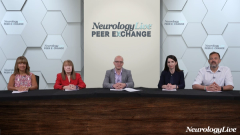
News|Videos|July 3, 2024
Monitoring Patients With Mild/Moderate Multiple Sclerosis
The key opinion leaders provide recommendations on the optimal frequency for evaluating disease progression in patients with mild to moderate MS, emphasizing effective monitoring methods and the most appropriate tools for best clinical practice.
Advertisement
Episodes in this series
How frequently should patients with mild to moderate MS be evaluated for disease activity and progression?
Advertisement
Related to this article

Laurie Gutmann, MD, chair of the Department of Neurology at Indiana University School of Medicine, discusses one-year pooled ACHIEVE data for z-basivarsen (DYNE-101), an investigational antisense oligonucleotide, in myotonic dystrophy type 1 (DM1).
Mind Moments®, a podcast from NeurologyLive®, brings you an exclusive interview with James F. Sumowski, PhD. [LISTEN TIME: 21 minutes]

Robert Bermel, MD, discusses advances in disease-modifying therapies, the challenges of monitoring MS progression, and emerging biomarkers and treatments that may address remaining unmet needs.

At a NeurologyLive Clinical Forum in Phoenix, Kevin J. Bielamowicz, MD, of Arkansas Children’s Hospital, discussed how a lack of adult neuro-oncology infrastructure is shaping how NF1-associated plexiform neurofibromas get recognized, referred, and treated.
The FDA granted fast track designation to FRP-003, an investigational oral botanical drug candidate for Long COVID, ahead of a planned phase 2 trial evaluating fatigue in approximately 220 adults.
GV101 receives FDA fast track designation for the treatment of Friedreich ataxia, with a phase 2 trial planned to begin enrollment in late 2026.

In honor of Veterans Day, Clayton Mucha, DO, neurorehabilitation physiatrist at Burke Rehabilitation in New York, discusses the lasting effects of traumatic brain injury in military personnel.

At a NeurologyLive Clinical Forum in New York, Mary Ann Piccone, MD, of Holy Name Medical Center, led a wide-ranging discussion among MS specialists on the limits of current high-efficacy therapies, the pipeline of emerging agents, and the gap between physician and patient treatment priorities.
Advertisement
Advertisement
Trending on NeurologyLive - Clinical Neurology News and Neurology Expert Insights
1
Phase 3 NIMBLE Trial: Cemdisiran Efficacy and Safety Results in gMG
2
FDA Grants Fast Track Status to FRP-003 for Long COVID Ahead of Phase 2 Study
3
Headlining Current Advances and Challenges in Multiple Sclerosis Care
4
GV101 Gains FDA Fast Track Status for Friedreich Ataxia Ahead of Phase 2 Trial
5