
Opinion|Videos|March 12, 2026
Rituximab in NMOSD: Managing Cumulative Infection Risk and Long-Term Tolerability
In this episode, the panel discusses the real-world safety signals seen with rituximab—particularly serious and recurrent infections—how to think beyond IgG levels alone, and what clinicians can do to better monitor and mitigate infectious risk while balancing relapse prevention.
Advertisement
Episodes in this series
Neuromyelitis optica spectrum disorder (NMOSD) is a relapse-driven disease in which long-term disability is closely tied to preventing inflammatory attacks. As more FDA-approved therapies enter the field, clinicians are increasingly tasked with weighing not only trial efficacy but also real-world safety, tolerability, and the durability of benefit over years of treatment.
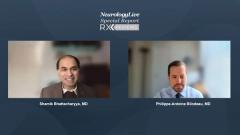
In this 5-part panel series, Shamik Bhattacharyya, MD, Anne M. Finucane Endowed Chair in Neurology and Associate Professor of Neurology at Harvard Medical School, and Philippe-Antoine Bilodeau, MD, of the Division of Neuroimmunology at Mass General Brigham and Instructor in Neurology at Harvard Medical School, unpack their comparative effectiveness study published in Neurology. Drawing on decades of real-world experience, they discuss how FDA-approved NMOSD therapies compare with rituximab and traditional immunosuppressants, and what the findings mean for everyday clinical decision-making.
In this episode, the conversation focuses on how clinicians should think about rituximab safety in practice. The panel reviews patterns of serious infections observed in long-term use, the role—and limitations—of hypogammaglobulinemia monitoring, and the clinical impact of frequent “non-serious” infections and infusion reactions that may not be fully captured in clinical trials but can substantially affect patient quality of life and treatment continuation.
Edited Transcript
Philippe-Antoine Bilodeau, MD:
Yes, I think there, as I mentioned earlier, we found a substantial risk of serious infectious adverse events or treatment-limiting adverse events, particularly on rituximab, but also even more so on azathioprine and mycophenolate.
The serious infections were varied. Many were pneumonias and UTIs. We also found a significant number of patients who were hospitalized with sepsis, and a nontrivial number of those had respiratory failure, for example, from pneumonia. This is something we had all observed clinically: the longer a patient is on treatment, there is probably cumulative toxicity, where their risk of infection goes up, particularly with B-cell therapy.
We know very well there is a risk of hypogammaglobulinemia, where IgG levels go down over time. This is something that can be seen early in clinical trials, and the incidence increases the longer patients remain on treatment. We think this likely contributes to infection risk.
One of the big questions in the field is whether there is a class effect—are some treatments, or some classes of treatments, safer than others? I think we will need larger cohorts and longer follow-up to answer that more definitively, but we tried to at least get an early signal.
Mechanistically, if you think about a complement inhibitor, it inhibits the terminal complement cascade and membrane attack complex formation. That is a very late event between antibody binding, complement fixation, and astrocyte injury. From a mechanistic standpoint, one might expect a lower risk of infections like UTIs and pneumonias, because patients may not be as broadly immunosuppressed as someone on rituximab. We did see an early signal of that: the risk of serious infections and treatment-limiting adverse events appeared lower on complement inhibitors, and the same was true for the composite endpoint.
At the same time, the risk-benefit balance in NMOSD is such that you are never going to get to a situation that is completely risk-free. We know a relapse is a very serious event, and there will be some risk with every therapy. But that risk may differ across treatments, and we may be able to be more thoughtful about which therapies we select for our patients.
Shamik Bhattacharyya, MD:
To add to that, with rituximab we often think about hypogammaglobulinemia alone as a proxy for infection risk. But what I think the study showed is that there were more serious infections than the prevalence of hypogammaglobulinemia. That suggests the immunosuppressive effects of rituximab are not occurring only through low IgG levels, but also through other mechanisms that suppress the immune system.
So when we get to the question of monitoring, immunoglobulin levels are important to follow, but they do not tell the whole story. Some patients may end up having recurrent infections even when immunoglobulin levels are not severely low. Conversely, some patients can have very low immunoglobulin levels and not experience recurrent infections. So the safety considerations likely need to be addressed on a patient-by-patient basis.
Philippe-Antoine Bilodeau, MD:
And just to add on the issue of tolerability, a lot of that was infusion reactions, which were particularly common on rituximab. I think many clinicians will appreciate that this happens frequently in their patients, and it seemed especially prevalent compared with some of the other treatments.
One issue we did not specifically analyze, but that I think is helpful to consider for future studies, is the issue of “non-serious” infections. In many clinical trials, a serious infection is defined as one requiring hospitalization. But when you speak to patients, and from clinical practice, we also see frequent non-serious infections.
I think this is something clinicians should be thoughtful about when we think about future studies and clinical trials: trying to quantify how often is too often. We had several patients who stopped therapy because they had their 10th episode of sinusitis. That clearly has a significant impact on quality of life, but it is often not captured in clinical trials because the follow-up is not long enough and because we do not always collect data on frequent infections.
That is something this study really highlighted for me—the impact of these frequent infections, even when they are not classified as serious, on quality of life.
Advertisement
Related to this article
Arimoclomol Plus Miglustat Shows Early, Sustained Slowing of Niemann-Pick Disease Type C Progression
A post hoc analysis of the phase 2/3 NPC002 trial presented at CNS 2026 showed that the benefit of arimoclomol plus miglustat in Niemann-Pick disease type C emerged as early as 3 months after treatment initiation.

The professor of neurology and program director of Neuromuscular Medicine at UC Irvine, discusses phase 3 NIMBLE trial findings for cemdisiran in generalized myasthenia gravis, including its novel siRNA mechanism, efficacy, and hospitalization data.

New 48-week phase 3 data show many patients with generalized myasthenia gravis reached minimal symptom expression on telitacicept, and most who did sustained it.
The Galassia trial will evaluate the safety and tolerability of intranasal cenegermin in about 60 children with spastic cerebral palsy across Italy.

New analyses found differences in functional outcomes over 2 years among patients aged 8 to 12 years treated with delandistrogene moxeparvovec, while separate findings characterized micro-dystrophin expression in children younger than 3 years.

The director of the Center for Neurological Restoration at Cleveland Clinic discusses when to transition beyond oral medication and considerations for selecting device-aided therapies in PD.

Here's some of what is coming soon to NeurologyLive® this week.

Test your neurology knowledge with NeurologyLive®'s weekly quiz series, featuring questions on a variety of clinical and historical neurology topics. This week's topic is recent therapeutic advances in MS!
Advertisement
Advertisement
Trending on NeurologyLive - Clinical Neurology News and Neurology Expert Insights
1
ELEVIDYS Shows Sustained Functional Differences vs External Controls in Older Ambulatory Duchenne Patients
2
Dompé Begins Phase 2 Trial Testing Intranasal Nerve Growth Factor for Cerebral Palsy
3
The Road Ahead for Precision Medicine in Multiple Sclerosis
4
Telitacicept Shows Deepening, Durable Response in Myasthenia Gravis
5