



MS and Demyelinating Disorders
Latest News

Advertisement
Latest Videos




CME Content










Advertisement
More News
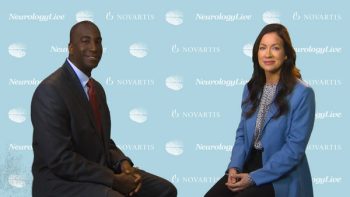
Sponsored By Novartis
Jason Freeman, MD, MBA, and Abby Rogers, DMSc, PA-C, MPAS, discuss a study presented at ACTRIMS 2023 on high-efficacy disease-modifying therapies for treatment-naïve patients with multiple sclerosis. Sponsored by Novartis.
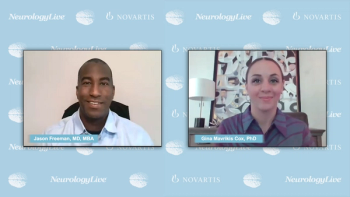
Sponsored By Novartis
Jason Freeman, MD, MBA, and Gina Mavrikis Cox, PhD, discuss a presentation from CMSC 2023 on the role of serum biomarkers in multiple sclerosis management. Sponsored by Novartis.

A new feature on NeurologyLive®, IJMSC Insights offers a closer look at the latest research and the people behind it from the community of the International Journal of Multiple Sclerosis Care (IJMSC) and the Consortium of Multiple Sclerosis Centers (CMSC).

Here's some of what is coming soon to NeurologyLive® this week.
A recent meta-analysis revealed significant differences in characteristic between patients with NMOSD and MS, highlighting the need for enhanced tools to differentiate between these diseases for early and accurate diagnosis.
Test your neurology knowledge with NeurologyLive®'s weekly quiz series, featuring questions on a variety of clinical and historical neurology topics. This week's topic is ataxia.

A recent subgroup analysis of the N-MOmentum study revealed that inebilizumab had equal efficacy in reducing attacks among Asian and nonAsian patients with NMOSD, demonstrating its continued superiority over placebo.
Take 5 minutes to catch up on NeurologyLive®'s highlights from the week ending December 15, 2023.
A new feature on NeurologyLive®, IJMSC Insights offers a closer look at the latest research and the people behind it from the community of the International Journal of Multiple Sclerosis Care (IJMSC) and the Consortium of Multiple Sclerosis Centers (CMSC).
A new feature on NeurologyLive®, IJMSC Insights offers a closer look at the latest research and the people behind it from the community of the International Journal of Multiple Sclerosis Care (IJMSC) and the Consortium of Multiple Sclerosis Centers (CMSC).
Here's some of what is coming soon to NeurologyLive® this week.
Test your neurology knowledge with NeurologyLive®'s weekly quiz series, featuring questions on a variety of clinical and historical neurology topics. This week's topic is ataxia.
Take 5 minutes to catch up on NeurologyLive®'s highlights from the week ending December 8, 2023.
Catch up on any of the neurology news headlines you may have missed over the course of November 2023, compiled all into one place by the NeurologyLive® team.

Results showed that evobrutinib did not produce a more superior reduction in annualized relapse rates than teriflunomide, a previously approved disease-modifying agent.

The clinical hold is in reference to safety concern observed in the phase 3 FENhance studies of patients with relapsing forms of multiple sclerosis.
Neurology experts discuss where BTKi’s fit in the multiple sclerosis treatment continuum.
Experts provide insights about what clinical measures they look for when treating patients with BTKis for multiple sclerosis.

Neurology experts discuss the potential effects of BTKi on chronic active lesions during multiple sclerosis therapies.
Here's some of what is coming soon to NeurologyLive® this week.
Test your neurology knowledge with NeurologyLive®'s weekly quiz series, featuring questions on a variety of clinical and historical neurology topics. This week's topic is the history of the American Epilepsy Society.
Take 5 minutes to catch up on NeurologyLive®'s highlights from the week ending December 1, 2023.
Neurology experts discuss the mechanism of action of BTKi’s for the treatment of multiple sclerosis.
Experts lead a discussion about potential safety concerns of BTKi’s when treating patients with multiple sclerosis.
Across 31 studies of patients with NMOSD, more than half of the patients included reported having sleep disturbances associated with their condition.
Advertisement
Advertisement
Trending on NeurologyLive - Clinical Neurology News and Neurology Expert Insights
1
uniQure Submits BLA for Gene Therapy in HD, AAN, AHS Issue Updated Guideline on Migraine Prevention, CTE Prevalence, Brain Donation Findings in Former NFL Players
2
EU Approves Modified-Release Carbidopa/Levodopa Capsules for Parkinson Disease Motor Fluctuations
3
American Academy of Neurology, American Headache Society Issue Updated Guideline on Migraine Prevention
4
Phase 4 Study Highlights Valbenazine's Positive Impact on Patient-Reported Quality of Life, Daily Functioning in Tardive Dyskinesia
5