

Challenges surrounding the use of telehealth for patients with Alzheimer disease are affected by technological barriers, according to the associate director of the Montefiore Hudson Valley Center of Excellence for Alzheimer’s Disease
Challenges surrounding the use of telehealth for patients with Alzheimer disease are affected by technological barriers, according to the associate director of the Montefiore Hudson Valley Center of Excellence for Alzheimer’s Disease
The panelists discuss the possibility of treating Dravet syndrome in older children and adults and the effects if the therapies were effective.
The director of the Montefiore Hudson Valley Center of Excellence for Alzheimer’s Disease discusses the use of telehealth for patients with Alzheimer disease during the COVID-19 pandemic, as well as her thoughts on why it is here to stay.
The panel discusses future gene therapies in development for Dravet syndrome.
Following the development and publication of consensus guidelines for the use of MRI in MS, Scott D. Newsome, DO, discusses next steps in adopting and implementing protocols to improve patient care.
Expert neurologists discuss the role of sphingosine-1-phosphate (S1P) receptor modulators in relapsing multiple sclerosis including vaccine considerations and pediatric use.
Key opinion leaders provide insight into the use cladribine for relapsing multiple sclerosis including durability and safety profile.

The neurologist from Cleveland Clinic discussed the importance of studying real-world outcomes in patients with migraine using CGRPs such as eptinezumab.

John Brandsema, MD, comments on the importance of patient compliance to therapy to manage spinal muscular atrophy.

Neurology News Network for the week ending July 17, 2021.

Experts in pediatric neurology share insights on the role of small molecule treatment for SMA through the recent FDA approval of risdiplam and discuss factors to consider when tailoring therapy for individual patients.

In discussion regarding the new MRI consensus guidelines for patients with MS, Scott D. Newsome, DO, and David Li, MD, FRCPC, discuss key points for their peers and colleagues.
Chaired by Brian G. Weinshenker, MD, the presentations also feature Mayo Clinic experts W. Oliver Tobin, MBBCh, BAO, PhD; Jessica Stulc, MD, MPH; and Orhun H. Kantarci, MD. [WATCH TIME: 1 hour, 30 minutes]

Implementing new recommendations for the use of MRI in patients with MS will be a challenge in terms of education and adherence; Scott D. Newsome, DO, and David Li, MD, FRCPC, discuss the next steps to increase awareness for both patients and providers.
Scott D. Newsome, DO, and David Li, MD, FRCPC, discuss the impact of new MRI consensus guidelines for patients with multiple sclerosis.

Just as sleep is a necessity each night, it is of further benefit when patients are recovering from injury in the hospital and rehabilitation settings.
The founder and chief scientific officer of Neurolutions discussed complexities within the system to integrate new stroke rehab devices.
Experts continue to explore connections between sleep health and neurological disorders, as well as technology for measuring patients’ sleep.
The associate professor of neurology at Washington University in St. Louis discussed how developing programs focused on sleep health are a step to increasing awareness and understanding its integral role in overall well-being.

Episode 12 of the AUPN Leadership Minute features Donald S. Higgins, Jr., MD, of the VHA and Albany Medical College; Clifton L. Gooch, MD, of the University of South Florida; and Sharyl Martini, MD, PhD, of the VHA and Baylor College of Medicine. [WATCH TIME: 4 minutes]
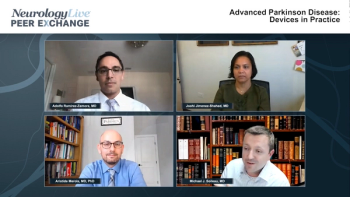
Experts discuss their personal experiences using technology and devices in advanced Parkinson disease management and identify patients that are adequately controlled with therapy.
Considerations of gastroparesis in patients with advanced Parkinson disease.

Joseph Sullivan, MD, provides an overview of the recent approval of fenfluramine oral solution for the treatment of Dravet syndrome.
Raman Malhotra, MD, associate professor of neurology at Washington University in St. Louis, commented on the importance of sleep education, particularly for younger generations.
Elaine C. Wirrell, MD, provides an overview of cannabidiol oral solution for treatment of seizures associated with Dravet syndrome.

The chief medical officer of Scholar Rock detailed the additive benefits apitegromab has in treating SMA when used with previously approved nusinersen.
Raman Malhotra, MD, associate professor of neurology at Washington University in St. Louis, discussed the importance inquiring about patients’ sleep, as well as the dangers of insufficient sleep.

The headache fellow at Cleveland Clinic outlined the design and reasoning for a new study assessing nerve blocks to treat COVID-19 headache.
Gavin Giovannoni, MD provides an overview of the development and pharmacodynamics of cladribine in multiple sclerosis.

Fred D. Lublin, MD, Ravi Dukkipati, MD, and Lauren Gluck, MD, discuss interferons and glatiramer as platform therapies in multiple sclerosis.