





Movement Disorders
Latest News
Advertisement
Video Series









Latest Videos





Shorts

0:35
What iPSC Models Miss About the Nervous System
a month ago
by
Ahmet Hoke, MD, PhD

1:28
Building a Smarter Drug Development Pipeline for Neuropathy
2 months ago
by
Ahmet Hoke, MD, PhD

0:48
Why Animal Models Still Matter in Neuropathy Research
2 months ago
by
Ahmet Hoke, MD, PhD
0:48
Breaking Down Tavapadon's Phase 3 Efficacy Results
2 months ago
by
Cindy Zadikoff, MD, MSc
0:57
Tavapadon's Potential Role Across the Parkinson Disease Spectrum
2 months ago
by
Cindy Zadikoff, MD, MSc
1:06
The Gut-Brain Connection in Parkinson Disease
3 months ago
by
Laurie Sanders, PhD(+1 more)

1:03
ATMRD 2026: Understanding Demoralization in Parkinson Disease
4 months ago
by
Indu Subramanian, MD(+1 more)
1:11
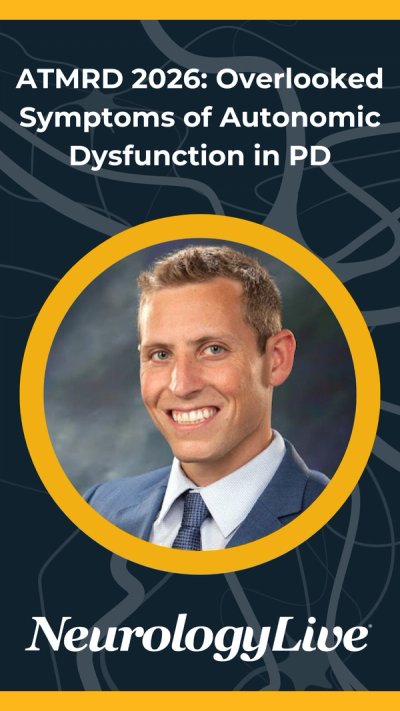
ATMRD 2026: Overlooked Symptoms of Autonomic Dysfunction in PD
4 months ago
by
Louie Pasculli(+2 more)

1:04
ATMRD 2026: Redefining Wellness in Parkinson Disease
4 months ago
by
Louie Pasculli(+1 more)

0:47
ATMRD 2026: The Future of Clinical Trials Is Closer to Home
5 months ago
by
David Shprecher, DO, MSci, FAAN(+1 more)
Podcasts
CME Content











Advertisement
More News

Episode 1 features a conversation with Ahmet Hoke, MD, PhD, of Johns Hopkins Medicine, discussing the clinical debate behind keeping animal models for neuropathy research vs switching to induced pluripotent stem cell models.

Newly published KINECT-PRO data showed that valbenazine boosted quality of life and function while reducing movement severity, with remission for many patients with tardive dyskinesia by 24 weeks.

Take 5 minutes to catch up on NeurologyLive®'s highlights from the week ending September 4, 2026.

Olfactory dysfunction, dysautonomia, mood disturbance, and motor deficits disproportionate to dopaminergic denervation may serve as markers of amyloid-β positivity in newly diagnosed Parkinson disease.
Catch up on any of the neurology headlines you may have missed in August 2026, compiled into 1 place by the NeurologyLive® team.

Newly published longitudinal fMRI data revealed that presymptom Huntington gene carriers had striatal network shifts up to 20 years early, potentially sharpening targets for studies in the future.

uniQure submitted a BLA to FDA and an MAA to the UK's MHRA for ifezuntirgene inilparvovec, based on 3-year phase 1/2 data showing slowed Huntington disease progression.

The European Commission approved modified-release carbidopa/levodopa capsules, already available in the US as Crexont, for adults with moderate to severe motor fluctuations.

An analysis of more than 311,000 UK Biobank participants identified 13 pairs and 14 triplets of risk factors with significant additive interactions for late-onset Parkinson disease, with several potentially modifiable factors emerging as targets for prevention.

Lucy Morse, MD, a movement disorders specialist at Northwestern Medicine, discussed the push toward a biological definition for Parkinson disease, newly approved therapies, and why she believes referrals shouldn't wait.

Findings from a phase 1 study showed that bilateral putaminal delivery of AAV2-GDNF using convection-enhanced delivery was well tolerated over 5 years, although exploratory clinical measures did not demonstrate significant improvements from baseline.

Test your neurology knowledge with NeurologyLive®'s weekly quiz series, featuring questions on a variety of clinical and historical neurology topics. This week's topic is Huntington disease!

Mind Moments®, a podcast from NeurologyLive®, brings you an exclusive interview with Pezhman Roohani, MD. [LISTEN TIME: 17 minutes]

Full results from the phase 3 TEMPO-2 trial, published in Lancet Neurology, showed that flexible-dose tavapadon significantly improved motor symptoms and daily function in people with early Parkinson disease.

A recently published phase 2 trial showed that CBD/THC cannabis oil failed to ease chronic pain or nonmotor symptoms versus placebo among patients with Parkinson disease.

David Stamler, MD, Chief Executive Officer of Alterity Therapeutics, discusses the FDA's alignment on the pivotal Phase 3 program for ATH434 in multiple system atrophy and what a successful trial could mean for a disease with no approved disease-modifying therapies.

Teva Pharmaceuticals' ecopipam receives priority review by the FDA, supported by studies showing sustained tic control among pediatric patients with Tourette syndrome.

Horacio Kaufmann, MD, Director of the Dysautonomia Center at NYU Langone, discusses the prospective validation of prodromal MSA criteria, how olfactory testing can sharpen specificity, and how close the field is to biomarker-driven early diagnosis.

Investigators independently tracked the 6 patients treated in a Parkinson disease gene therapy trial that was abandoned mid-study after its sponsor became insolvent, finding a reassuring safety profile and mixed signals of motor benefit through up to 3 years.
Take 5 minutes to catch up on NeurologyLive®'s highlights from the week ending August 7, 2026.

Topline findings from the Phase 2 SUNRISE-PD study showed statistically significant improvements in clinical measures, inflammatory biomarkers, and exploratory neurodegeneration markers among patients with early Parkinson disease treated with bezisterim.
Six FDA PDUFA decisions this fall could reshape care in Alzheimer disease, DMD, Sanfilippo syndrome, Alexander disease, and SMA, here's what clinicians need to know about the data behind each.

The associate professor of neurology at Duke University School of Medicine discussed a multicenter initiative studying gut-brain communication in Parkinson disease. [WATCH TIME: 4 minutes]

The FDA has granted Regenerative Medicine Advanced Therapy designation to sasineprocel, an autologous cell therapy for Parkinson disease, based on early data from the ongoing ASPIRO trial.
Mind Moments®, a podcast from NeurologyLive®, brings you an exclusive interview with neuro-oncologist Na Tosha Gatson, MD, PhD, FAAN. [LISTEN TIME: 20 minutes]
Advertisement
Advertisement
Trending on NeurologyLive - Clinical Neurology News and Neurology Expert Insights
1
Remibrutinib Lowers Relapse Rate vs Teriflunomide in Relapsing MS
2
FDA Accepts Troriluzole NDA Resubmission for Spinocerebellar Ataxia
3
Real-World Data Show Switch to Subcutaneous Ocrelizumab Well Tolerated
4
Tenecteplase Benefit Before Thrombectomy Varies by Stroke Cause, Study Shows
5