
Study establishes protocols for ublituximab use in breastfeeding patients with MS, enhancing treatment decision-making.
Study establishes protocols for ublituximab use in breastfeeding patients with MS, enhancing treatment decision-making.

The phase 3 trials are expected to assess the therapeutic potential of frexalimab dosed every 4 weeks in both patients with relapsing MS and non-relapsing secondary progressive MS.

Known for his expertise in stem cell transplantation, Cleveland Clinic researcher Jeffrey Cohen, MD, shifted gears to discuss other cell-based therapies in his Whitaker Lecture at the CMSC Annual Meeting.

Neurology News Network for the week ending June 1, 2024. [WATCH TIME: 4 minutes]

CMSC speakers discussed how AI technologies, for better or worse, are beginning to shape the management of MS.

Host Jeffrey Wilken, PhD, chats with Marijean Buhse, PhD, RN, NP-C, MSCN; Amy Sullivan, PsyD, ABPP; and John DeLuca, PhD, ABPP, FACRM, FAPA, FAPS, FNAN, about the third day of the 2024 CMSC Annual Meeting in Nashville, Tennessee.

The professor of psychiatry at the University of Toronto discussed the various medications for multiple sclerosis fatigue that have been tested but ultimately fail to outperform placebo. [WATCH TIME: 4 minutes]

The professor of neurology in the department of medicine, surgery, and neuroscience at the University of Siena, gave perspective on an analysis of the MAGNIFY-MS study, in which treatment with cladribine demonstrated impacts on CNS-related pathology in MS. [WATCH TIME: 4 minutes]

Florida-based neurologist Donal Negroski, MD, presents data from an aging MS patient population looking for treatment options under Medicare.

Fred Lublin, MD, the CMSC Presidential Lecture speaker, offers updated views on how to define MS clinical progression.
In comparison with adults on ocrelizumab, pediatric patients experienced no clinical relapses and a safety profile that was similar to what was previously observed.

A recent survey reported a high prevalence of burnout among physicians treating patients with multiple sclerosis, highlighting long work hours as one of the key factors.
Host Jeffrey Wilken, PhD, chats with Fred Lublin, MD; Brian Hutchinson, PT, MSCS; and Robert Motl, PhD, about the second day of the 2024 CMSC Annual Meeting in Nashville, Tennessee.
Within a subgroup of those older than 50 years, most patients who switched to cladribine were relapse free at follow-up, with no new safety signals observed.

The clinical research director of the UCSF Multiple Sclerosis Center talked about results from clinical trials assessing BTK inhibitors in relapsing multiple sclerosis and the ongoing research to explore more effective treatments. [WATCH TIME: 5 minutes]

MS does not carry an increased risk of high-risk pregnancy, but many clinicians are unclear about best practices for managing these patients.

CMSC Kurtzke Lecturer Darin Okuda, MD, demonstrates innovative ways to rethink MRI use in MS.
In a new analysis of the CHIMES trial, ocrelizumab displayed a trend toward improved work productivity among minority patients with relapsing multiple sclerosis.
Host Jeffrey Wilken, PhD, chats with Robert Naismith, MD; Jiwon Oh, MD, PhD; and Anthony Traboulsee, MD, about the first day of the 2024 CMSC Annual Meeting in Nashville, Tennessee.

Over a 24-month treatment period, patients on cladribine demonstrated no axonal loss evident on OCT, with reductions in cerebrospinal fluid neurofilament light and impacts on oligoclonal bands.
The clinical research director of the UCSF Multiple Sclerosis Center discussed the early-onset progression in multiple sclerosis and emphasized the need for targeted therapies in this patient population. [WATCH TIME: 6 minutes]
Nearly half of patients on diphenhydramine, dexamethasone, and famotidine experienced moderate to severe decreased alertness vs only 12.9% of those on cetirizine, dexamethasone, and famotidine.

Over a 5-year treatment period, patients on ofatumumab, regardless of race or ethnicity, demonstrated significant reductions in neurofilament light and achieved consistent rates of NEDA-3.
Overall, the results mirrored previous reports demonstrating that patients on ocrelizumab before or during pregnancy did not have elevated risk of adverse pregnancy and infant outcomes.
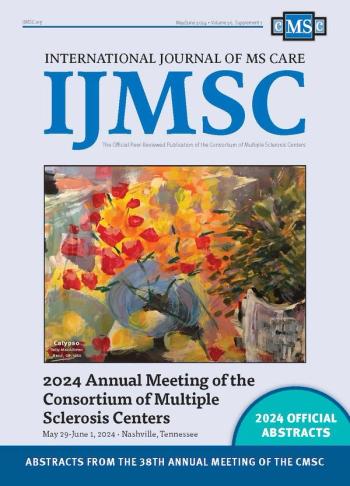
The 38th CMSC Annual Meeting is set to be held May 29-June 1, 2024, in Nashville, Tennessee. The International Journal of MS Care has published the abstracts.
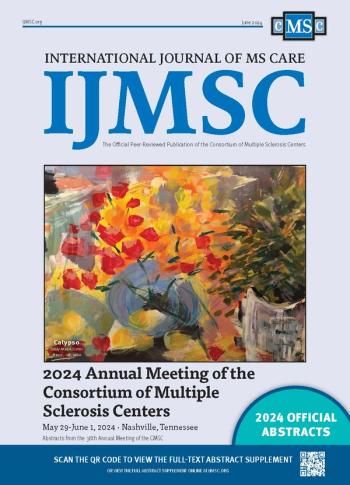
The International Journal of MS Care publishes the abstracts for the CMSC Annual Meeting, which is set to be held May 29-June 1, 2024, in Nashville, Tennessee.
The Consortium of Multiple Sclerosis Centers' 38th Annual Meeting will be held Wednesday, May 29, through Saturday, June 1, 2024 at the Music City Center, in Nashville, Tennessee.
The award ceremony is supported by EMD Serono and Viatris and will take place on Thursday, May 30, 2024, at the Nashville Music City Center in Nashville, Tennessee, during the 2024 CMSC Annual Meeting.
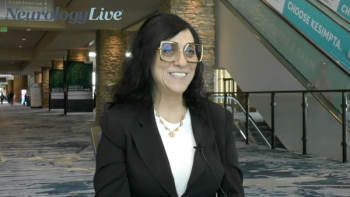
The assistant professor at Hunter College discussed the importance of using a systematic approach to localization and thorough consideration of clinical symptoms to enhance diagnostic accuracy and reduce misdiagnosis in multiple sclerosis. [WATCH TIME: 4 minutes]

The associate professor in the department of population and quantitative health sciences at Case Western Reserve University School of Medicine talked about striving to understand and address the disparities among Latinx patients with multiple sclerosis. [WATCH TIME: 2 minutes]