
Vatiquinone Recieves CRL, RAINBOWFISH Study Published in NEJM, Hearing Aids Show Protective Effects Against Dementia
Published: | Updated:
Neurology News Network. for the week ending August 23, 2025. [WATCH TIME: 4 minutes]
Neurology News Network. for the week ending August 23, 2025. [WATCH TIME: 4 minutes]
The professor and chair of neuroscience at UT Southwestern Medical Center discussed how circadian clock genes regulate cellular metabolism and potentially influence headache. [WATCH TIME: 6 minutes]
The headache neurologist at the Barrow Neurological Institute talked about an international expert panel that established agreed-upon definitions for refractory and resistant migraine. [WATCH TIME: 4 minutes]
At AHS 2025, the associate clinic director at the UC San Diego talked about the cautious use of cannabinoids in migraine and the importance of standard therapies before cannabinoids. [WATCH TIME: 3 minutes]

Panelists discuss how newer medications such as stiripentol have become preferred over traditional options such as valproate for younger patients, emphasizing the importance of assessing treatment effectiveness within 6 to 8 weeks rather than accepting "pretty good" seizure control, and encouraging frequent communication with families to optimize therapy and pursue meaningful seizure reduction rather than settling for partial improvements.
The director of the Brotman Facial Pain Clinic at the University of Maryland talked about emerging preclinical evidence supporting adenosine A3 receptor activation for post-traumatic trigeminal neuropathic pain. [WATCH TIME: 5 minutes]
Panelists discuss how treatment selection for Dravet syndrome requires individualized approaches based on seizure types and patient characteristics, emphasizing the importance of striving for seizure freedom, avoiding contraindicated sodium channel medications, utilizing synergistic drug combinations when appropriate, and simplifying medication regimens to twice-daily dosing with clear timing cues to improve family adherence to complex treatment plans.
The chief scientific officer at Alzheon talked about a symposium on the role of amyloid-beta oligomers in AD and phase 3 clinical data of valiltramiprosate presented at AAIC 2025. [WATCH TIME: 5 minutes]
The physician assistant specializing in Parkinson disease talked about how comorbidities and patient preference guide clinical decisions in prescribing on-demand therapies for Parkinson disease. [WATCH TIME: 5 minutes]
The CEO and cofounder of LSVT Global highlighted the importance of clinicians referring their patients with Parkinson disease early to evidence-based physical therapies, occupational therapies, and speech therapies. [WATCH TIME: 5 minutes]
The Harold I. Nemuth Chair in Neurological Disorders at Virginia Commonwealth University provided hypothetical insights on potential stroke-related avenues for GLP-1 RAs to treat following positive data in idiopathic intracranial hypertension. [WATCH TIME: 4 minutes]
An expert discusses how a 13-year-old boy with Duchenne muscular dystrophy faces the challenging transition to complete loss of ambulation, emphasizing the importance of gradual introduction of assistive devices and psychological support during this developmentally difficult period.
An expert discusses how a 13-year-old boy with Duchenne muscular dystrophy faces the challenging transition to complete loss of ambulation, emphasizing the importance of gradual introduction of assistive devices and psychological support during this developmentally difficult period.
At AAIC 2025, the founder and CEO at Veravas discussed the company’s VeraBIND tau pathology blood test, highlighting its potential to detect Alzheimer disease earlier with high accuracy. [WATCH TIME: 4 minutes]
At AAIC 2025, the chief executive officer at ALZpath discussed the growing adoption of the company’s pTau217 antibody blood test for AD research, emphasizing its potential role in early detection. [WATCH TIME: 4 minutes]
The principal scientist of neuroscience discovery at Merck presented preclinical data at AAIC 2025 supporting the development of MK-2214, an anti-tau antibody designed to slow or prevent the progression of AD. [WATCH TIME: 5 minutes]
Panelists discuss how they select between wake-promoting medications (modafinil, armodafinil, and solriamfetol) by explaining neurotransmitter mechanisms to patients while acknowledging that practical factors like insurance coverage and accessibility often drive treatment decisions more than theoretical mechanisms.
Panelists discuss how they approach measuring sleepiness in patients with OSA, with emphasis on trusting patient reports over relying solely on objective tests like the Epworth Sleepiness Scale, which they view as a useful screening tool but inadequate by itself due to patients often minimizing their symptoms.
Neurology News Network. for the week ending August 16, 2025. [WATCH TIME: 4 minutes]
The medical director of CNS clinical cevelopment at AskBio discussed long-term data presented at ATMRD from the company’s phase 1b trial assessing the investigational gene therapy AB-1005 in Parkinson disease. [WATCH TIME: 6 minutes]
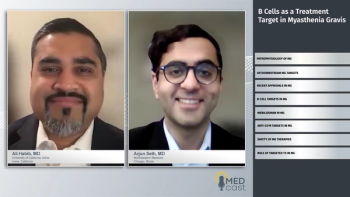
Ali Habib, MD, and Arjun Seth, MD, discuss how B-cell–targeted therapies represent a promising upstream treatment approach for myasthenia gravis that could provide more sustained efficacy compared with current downstream treatments like complement inhibitors and FcRn antagonists, with CD19-targeting agents like inebilizumab showing particular promise in clinical trials for both acetylcholine receptor and MuSK antibody subtypes.
The Harold I. Nemuth Chair in Neurological Disorders at Virginia Commonwealth University discussed the next steps in advancing GLP-1s for idiopathic intracranial hypertension and the research necessary to further understand their therapeutic impact. [WATCH TIME: 3 minutes]
At CMSC 2025, assistant professor of neurology at the University of California, San Francisco discussed progress on the integration of biomarkers into clinical practice for multiple sclerosis. [WATCH TIME: 4 minutes]
Panelists discuss how the treatment paradigm for Dravet syndrome has dramatically shifted with newer FDA-approved medications (cannabidiol, stiripentol, and fenfluramine) now recommended as first- and second-line therapies alongside traditional options such as valproate and clobazam, emphasizing that these novel mechanisms offer distinct advantages and should be used early rather than as last-resort treatments, with risk evaluation and mitigation strategies (REMS) programs and specialty pharmacies actually improving patient access and monitoring.
The clinical assistant professor in movement disorders at Jefferson Health outlined a patient-centered, lifestyle-first approach to managing Parkinson nonmotor symptoms. [WATCH TIME: 4 minutes]
Panelists discuss how patients with Dravet syndrome face elevated sudden unexplained death in epilepsy (SUDEP) risk compared with other epilepsy populations, emphasizing the importance of early family education about risk factors such as convulsive seizures and medication adherence, while highlighting that newer therapies show promise in reducing both seizure frequency and SUDEP risk through better seizure control and decreased status epilepticus occurrence.
The associate professor of neurology at Johns Hopkins Medicine previewed a 2025 AUPN panel exploring AI’s clinical, research, and educational applications, along with the ethical considerations shaping its responsible adoption. [WATCH TIME: 2 minutes]

The chief medical officer at Acumen Pharmaceuticals discussed the benefits of using the blood-based p-tau 217 biomarker to improve screening accuracy and reduce patient burden in AD. [WATCH TIME: 5 minutes]
The Harold I. Nemuth Chair in Neurological Disorders at Virginia Commonwealth University detailed published findings on GLP-1 receptor agonists significantly improving outcomes and lowering mortality in idiopathic intracranial hypertension, regardless of BMI. [WATCH TIME: 5 minutes]
Panelists discuss how FDA-approved medications like modafinil, armodafinil, and solriamfetol serve both therapeutic and diagnostic purposes in treating residual sleepiness, with responses varying across different sleep disorder populations but consistently helping patients recognize their true level of impairment.