
Commentary|Videos|March 30, 2026
From Guidelines to Practice: Challenges in Applying Updated MS Diagnostic Criteria
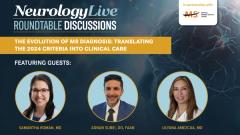
A group of neuroimmunologists discuss how the updated McDonald criteria will shape neurologist training and highlight key barriers to implementation, including imaging access, resource limitations, and knowledge dissemination.
Advertisement
In collaboration with the National MS Society, NeurologyLive® convened a roundtable discussion featuring leading multiple sclerosis experts to examine the evolving 2024 McDonald diagnostic criteria and their real-world implications. Moderated by Marco Meglio, assistant managing editor of NeurologyLive, the panel includes Samantha Roman, MD; Adnan Subei, DO, FAAN; and Lilyana Amezcua, MD, who bring perspectives across both academic and community neurology practice.
As the diagnostic framework for MS becomes increasingly complex and biology-driven, education and implementation are critical to ensuring these updates translate into meaningful clinical impact. The panel emphasizes that while newer generations of neurologists may be trained with these criteria from the outset, many practicing clinicians will need to adapt to new imaging markers, biomarker integration, and evolving diagnostic pathways.
In this final episode, the discussion centers on how the updated criteria will influence training, including the growing importance of recognizing subtle MRI features and integrating emerging tools such as artificial intelligence into education and case-based learning. Panelists also highlight ongoing efforts by organizations such as the National MS Society and the American Academy of Neurology to disseminate these updates and support clinician education.
Beyond training, the conversation addresses key barriers to real-world implementation, including limited access to advanced MRI technology, variability in imaging quality across practice settings, lack of availability of tests such as kappa free light chains, and challenges faced by community neurologists who may see fewer MS cases. These factors underscore the need for continued collaboration, standardization, and resource expansion to ensure equitable adoption of the updated criteria across all care settings.
Explore the Full Series!
Transcript edited for clarity.
Marco Meglio (moderator): We are on to the final topic, and thank you again for taking some time out of your day. This has been a really fun and insightful discussion, with a lot of great perspectives from all of you. So thank you. The last topic we are going to talk about is this diagnostic criteria and the new elements that come with it. With that comes a learning curve, especially for younger neurologists who are early in their training or clinical practice. Can you talk about how these guidelines might impact training from an educational standpoint as they are applied in clinical care?
Samantha Roman, MD: I definitely feel that imaging is emphasized during training, but it will become even more important to recognize some of these subtle findings. Residents and fellows will need to learn how to identify these features. Those who are earlier in their careers may need to learn this in real time, possibly without having as many direct patient examples, which could make it more challenging compared with those currently in training at larger academic centers where these criteria are adopted earlier. These imaging findings will likely become a standard part of training as part of the diagnostic criteria.
Lilyana Amezcua, MD: I also think that artificial intelligence could be helpful in education, particularly through case-based learning and webinars. This may be especially useful for community neurologists who are less familiar with advanced imaging techniques in MS. There is an opportunity to expand education in this space, and new trainees will likely approach MS very differently compared with how it was approached 20 years ago.
Adnan Subei, DO, FAAN: There are also initiatives from organizations such as the National MS Society to help disseminate the updated diagnostic criteria and educate neurologists in the community. The American Academy of Neurology also offers sessions each year that review these criteria.
Marco Meglio: As a final question, we have talked about education, but let’s also discuss application of these guidelines in clinical practice. Can you speak to some of the access challenges related to the revised criteria, including barriers to implementation that will need to be addressed for broader adoption?
Lilyana Amezcua, MD: One challenge is access to advanced MRI technology. Not all patients have access to 3.0 Tesla MRI scanners, which are often needed to visualize features such as central vein sign and paramagnetic rim lesions. Many patients may only have access to lower-strength scanners, such as 1.5 Tesla, which limits detection of these findings. This is particularly relevant in under-resourced settings and rural regions.
There are also challenges related to provider experience. More specialized clinicians may be more comfortable applying these criteria, while community neurologists who see fewer MS cases may find it more difficult to adopt them. Awareness of these differences is important as we think about broader implementation.
Efforts from advocacy groups, professional societies, and ongoing educational initiatives may help address some of these gaps over time.
Adnan Subei, DO, FAAN: Another barrier is access to diagnostic testing such as kappa free light chains. In some regions, these tests are not yet readily available and may require send-out testing. Expanding access to these tools will be an important step in applying the criteria more consistently.
Samantha Roman, MD: Finally, a major challenge is simply disseminating knowledge of the updated criteria. General neurologists must stay current across many areas of neurology, and it can be difficult to keep up with evolving guidelines. Continued education through conferences, seminars, and professional organizations will be essential to ensure widespread understanding and adoption.
Advertisement
Related to this article
MS Compass: Guiding Clinical Care, a podcast hosted by neuroimmunologist Lindsay Ross, MD, brings you an exclusive interview with Rachel Galioto, PhD. [LISTEN TIME: 33 minutes]

Here's some of what is coming soon to NeurologyLive® this week.

New data from a Cure SMA survey showed that children treated with disease-modifying therapy soon after birth walk more often and have fewer comorbidities than those treated later.
The professor of neurology at the University of Lyon and 2026 Rachel Horne Prize Winner discussed pregnancy counseling, therapeutic inertia, and overlooked women's health issues in multiple sclerosis.
The Accelerating Access to Critical Therapies for ALS Reauthorization Act of 2026 extends federal support for ALS research and expanded access to investigational therapies, with additional provisions addressing clinical trial oversight and regulatory planning.

Mind Moments®, a podcast from NeurologyLive®, brings you an exclusive interview with Katherine Matthews, MD. [LISTEN TIME: 17 minutes]
The FDA accepted fenebrutinib's new drug application under priority review for relapsing and primary progressive MS, based on 3 phase 3 trials comparing the BTK inhibitor with teriflunomide and ocrelizumab.
The chairman of the Neurology Service Line at Baptist Health in Kentucky discussed PREVIEW trial findings for gefelorilimab in generalized myasthenia gravis, including efficacy, safety, and what the subcutaneous C5 inhibitor could offer patients if approved.
Advertisement
Advertisement
Trending on NeurologyLive - Clinical Neurology News and Neurology Expert Insights
1
Phase 3 PROPEL Trial to Test Imeroprubart in Generalized Myasthenia Gravis
2
Nipocalimab’s Safety Profile Slightly Favored Over Other Myasthenia Gravis Therapies, Indirect Comparison Shows
3
2026 Rachel Horne Prize Winner Sandra Vukusic, MD, PhD, on Advancing Women's Health in MS
4
Early Spinal Muscular Atrophy Treatment Tied to Milder Pediatric Phenotype
5