
Opinion|Videos|February 5, 2024
How to Address Increasing Neurofilament Light Chain Levels
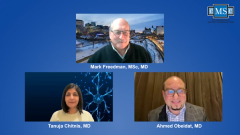
Tanuja Chitnis, MD, shares possible course of action if NFL levels begin to rise during treatment.
Advertisement
Episodes in this series
Tanuja Chitnis, MD, expresses a preference for conducting an MRI and personally examining the patient to gather a comprehensive understanding of the situation. She emphasizes the need to identify potential asymptomatic new changes on the neurological exam. Additionally, she acknowledges that the level of comfort and confidence in interpreting NFL changes may evolve in the future.
Video synopsis is AI-generated and reviewed by HCPLive® editorial staff.
This program is supported by Novartis Pharmaceuticals Corporation. Content is independently developed by CMSC.
Advertisement
Related to this article

Here's some of what is coming soon to NeurologyLive® this week.

Ocrelizumab demonstrated noninferiority to fingolimod for relapse control but displayed greater reductions in MRI lesion activity among pediatric patients with relapsing-remitting multiple sclerosis.

Take 5 minutes to catch up on NeurologyLive®'s highlights from the week ending October 16, 2026.

Findings from the phase 3 METEOROID trial showed that satralizumab reduced the risk of relapse in patients with relapsing myelin oligodendrocyte glycoprotein antibody-associated disease.
Here's some of what is coming soon to NeurologyLive® this week.

Catch up on any of the neurology headlines you may have missed in September 2026, compiled into 1 place by the NeurologyLive® team.
Advertisement
Advertisement
Trending on NeurologyLive - Clinical Neurology News and Neurology Expert Insights
1
Ocrelizumab Shows MRI Benefits vs Fingolimod in Phase 3 Pediatric-Onset Multiple Sclerosis Study
2
RGX-202 Meets Primary End Point in Phase 3 Duchenne Trial
3
FDA Approves Autoinjector for Self-Administered Zilucoplan in Generalized Myasthenia Gravis
4
ELEVIDYS Shows Functional Benefits in Patients With DMD, Dompé Launches Phase 2 Trial of Intranasal Nerve Growth Factor in CP, NeurologyLive Roundtable: The Road Ahead for Precision Medicine in MS
5