
In early-morning shift workers with shift work disorder, solriamfetol significantly improved objective and subjective measures of sleepiness compared with placebo in a trial published in the New England Journal of Medicine.

Louie Pasculli, Assistant Editor for NeurologyLive®, has been with the team since October 2025. Follow him on X @Louie_Pasculli or email him at lpasculli@neurologylive.com
In early-morning shift workers with shift work disorder, solriamfetol significantly improved objective and subjective measures of sleepiness compared with placebo in a trial published in the New England Journal of Medicine.

Kyle Marden, MD, sports neurologist at Northwestern Medicine, discussed the growing role of sports neurologists and new data supporting the feasibility of quantitative pupillometry as part of a multimodal approach to concussion diagnosis and recovery tracking.
Off-label rimegepant was associated with patient-reported acute migraine improvement and no new safety signals in a small retrospective review of adolescent patients.
Test your neurology knowledge with NeurologyLive®'s weekly quiz series, featuring questions on a variety of clinical and historical neurology topics. This week's topic is Dravet syndrome treatment paradigm!

Experts shared their clinical perspectives on trending topics at the 2026 Americas Committee for Treatment and Research in Multiple Sclerosis (ACTRIMS) Forum, held February 5-7, 2026.
An associate professor in neurosurgery at Duke University discussed his presentation on novel meningeal immune interactions and interferon signaling in multiple sclerosis at the ACTRIMS Forum 2026. [WATCH TIME: 3 minutes]
The FDA granted premarket approval to Balt Inc.’s Squid liquid embolic agent for middle meningeal artery embolization, offering a minimally invasive option to reduce treatment failure in patients with large symptomatic chronic subdural hematomas.
A pediatric neurologist at the UCL Institute of Neurology in London, England discussed how pediatric-onset MS is marked by intense inflammation, unique neurodevelopmental considerations, and evolving treatment paradigms at ACTRIMS 2026. [WATCH TIME: 5 minutes]
A professor of neurology from the University of Barcelona discussed the clinical implications of adding intra-arterial alteplase after thrombectomy in patients with Large-vessel occlusion (LVO) acute ischemic stroke at ISC 2026.
Test your neurology knowledge with NeurologyLive®'s weekly quiz series, featuring questions on a variety of clinical and historical neurology topics. This week's topic is on FDA-Approved Drugs for Duchenne Muscular Dystrophy!

An interim DSMB review halted the rivaroxaban arm of the NIH-funded CAPTIVA trial in symptomatic intracranial atherosclerotic stroke due to increased safety events and futility compared with standard dual antiplatelet therapy.
The Allen Geller distinguished professor of immunology at Duke University School of Medicine discusses the connection between Epstein Barr Virus and Multiple Sclerosis, citing decades of research that position EBV as a leading environmental risk factor and a potential therapeutic target in MS. [WATCH TIME: 4 minutes]
Fremanezumab, a humanized monoclonal antibody that selectively targets calcitonin gene–related peptide, demonstrated efficacy in children and adolescents with episodic migraine in full data release.
Late-breaking data from the 2026 ACTRIMS Forum showed that bazedoxifene acetate failed to improve remyelination outcomes in midlife women with relapsing MS, despite a favorable safety profile.
The associate professor of neurology at the University of California, San Francisco discussed the evolving approach to remyelination in patients with MS at the 2026 ACTRIMS Forum. [WATCH TIME: 3 minutes]
Test your neurology knowledge with NeurologyLive®'s weekly quiz series, featuring questions on a variety of clinical and historical neurology topics. This week's topic is on diagnosing parasomnias!

The single-arm CLAD-MAPET study is evaluating whether cladribine tablets reduce microglial activation, captured by [F-18]PBR06-PET, in patients with MS experiencing progression without relapse or MRI activity on anti-CD20 therapy.

Adding intra-arterial alteplase after successful endovascular thrombectomy significantly improved 90-day functional outcomes in patients with large-vessel acute ischemic stroke, according to late-breaking data from the phase 3 CHOICE2 trial.

In honor of National Women Physician’s Day, the NeurologyLive® team highlighted recent studies on women transforming neurologic care and advancing women’s health.
Aleksandra Pikula, MD, DipABPN, DipABLM, FELMO, director of the JS Sonshine Center, shares her personal view on National Women Physician’s and why it’s important for clinicians and patients in the field.
Riley Bove, MD, MS, associate professor of neurology at the University of California San Francisco, shares her personal view on National Women’s Physician’s and why it’s important for clinicians and patients in the field.
The FDA approves the FreedomEDGE infusion platform for rozanolixizumab, enhancing treatment options for generalized myasthenia gravis in clinical settings.
Anti–IL-6R receptor therapy may offer a new treatment option for patients with NMOSD and MOGAD who do not respond to rituximab, according to new findings.
Test your neurology knowledge with NeurologyLive®'s weekly quiz series, featuring questions on a variety of clinical and historical neurology topics. This week's topic is on the ACTRIMS and its history!
A study of 614 brain donors revealed that individuals with stage III or IV CTE face the greatest risk of dementia.

Trial data showed that treatment with lamotrigine reduced myotonia severity in adults with genetically confirmed non-dystrophic myotonias, with sustained benefit and an acceptable safety profile.

Head-to-head PET imaging data indicated that valbenazine achieves significantly higher VMAT2 target occupancy than deutetrabenazine XR at therapeutic doses, with both treatments remaining well tolerated.

In a recently published study, integrating prehospital GFAP measurements with established stroke scales significantly improved the accuracy of large vessel occlusion detection in patients with acute stroke.
Test your neurology knowledge with NeurologyLive®'s weekly quiz series, featuring questions on a variety of clinical and historical neurology topics. This week's topic is on the ALS Treatment pathways!
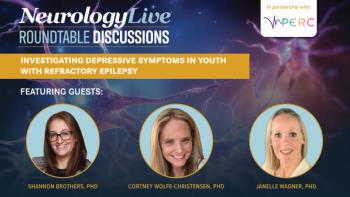
Pediatric specialists stressed that the future of epilepsy care may involve embedding behavioral health clinicians in specialty clinics to identify and treat depression early, improve quality of life, and potentially reduce seizure burden. [WATCH TIME: 3 MINUTES]