

The Novartis agent showed benefit in patients who had multiple sclerosis both with and without relapses.
The Novartis agent showed benefit in patients who had multiple sclerosis both with and without relapses.

Patricia Melville, NP-C, MSCN, and Marijean Buhse, PhD, NP-C, MSCN, present their lecture titled, "Comorbidities and MS: Critical Thinking About DMTs and Vaccines" as part of the 2020 CMSC Virtual Annual Meeting.

Amy Sullivan, PsyD, ABPP, presents her lecture titled, "Science, Art, and Practice of Behavioral Medicine" as part of the 2020 CMSC Virtual Annual Meeting.

Brian Weinshenker, MD presents his lecture titled, "Neuromyelitis Optica Spectrum Disorders: Emerging Treatment Options" as part of the 2020 CMSC Virtual Annual Meeting.
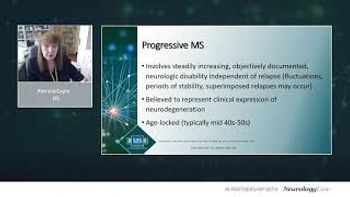
Patricia Coyle, MD, delivers her lecture titled, "Progressive MS: Diagnosis, Clinical Course and Long-Term Management" as part of the 2020 CMSC Virtual Annual Meeting.

Evobrutinib, a highly selective BTK inhibitor for the treatment of relapsing multiple sclerosis, showed long-term safety and success in reducing annualized relapse rates.
The Genentech agent, which is approved for patients with relapsing-remitting multiple sclerosis, showed no new safety signals in a comparison between conventional and shorter infusion times.

Novartis’s anti-CD20 monoclonal antibody has been shown to increase the odds of patients with multiple sclerosis achieving no evidence of disease activity status by more than 3-fold in the first year and more than 8-fold in the second year.

The director of behavioral medicine at the Mellen Center for MS Treatment and Research at Cleveland Clinic detailed the need to incorporate interdisciplinary care and behavioral medicine in commonplace MS practice.

The director of the multiple sclerosis research unit at Ottawa Hospital discussed stem cell therapies being explored in multiple sclerosis, and which patients may be eligible for these treatments.

The chief of the Division of Neurology at Children’s Hospital of Philadelphia spoke to the need for clinical trial evidence and research for the pediatric MS population.

The director of behavioral medicine at the Mellen Center for MS Treatment and Research at Cleveland Clinic discussed the importance of interdisciplinary care and ways it can be incorporated for patients with multiple sclerosis.

The MS neurologist at Cleveland Clinic’s Lou Ruvo Center for Brain Health discussed the impact that propensity score has had on real-world data analysis, the use of additional outcome measures in trials, and the increasing understanding of progressive disease.

The podiatrist and chief executive officer of Naboso Technology spoke about the potential of textured insoles to help patients with multiple sclerosis improve gait, posture, and balance.
The director of behavioral medicine at the Mellen Center for MS Treatment and Research at Cleveland Clinic discussed the importance of screening patients with MS for other conditions for which they are prevalently comorbid, such as depression or sleep disorders.

The director of rehabilitation services at Cleveland Clinic Mellen Center for MS spoke about the impact that participation in the arts can have for individuals with multiple sclerosis in dealing with symptoms of their disease.
The director of MS neuropsychiatry at Brigham and Women’s Hospital spoke of the importance of not oversimplifying the approach to mental health disorders in individuals with MS, and how the collaborative care model can help.­­­

Many patients with neurologic conditions such as multiple sclerosis are faced with gait and stability issues due to their disease, but Splichal and Naboso Technology seek to address these issues via mechanoreceptor stimulation.
The director of Behavioral Medicine at the Mellen Center for MS Treatment and Research at the Cleveland Clinic spoke about the importance of caring for patients with MS by using a team-based approach.

The chairman of the Department of Neuroscience at the Lerner Research Institute spoke about what the implications of the new subtype of MS could be in the understanding of the disease.
The MS neurologist at Cleveland Clinic’s Lou Ruvo Center for Brain Health discussed how leveraging real-world datasets can help reduce indication bias when comparing treatments for multiple sclerosis.

Patients with favorable prognostic profiles or relapsing-remitting MS are the least likely to initiate high-efficacy disease-modifying therapies recommended by their physician, with many patients citing access challenges.
Despite high rates of depression in MS, picking up on signs that an individual may be at risk for suicide can be difficult. The staff neurologist at Cleveland Clinic’s Mellen Center discussed some of the red flags.

Results of a pooled analysis of 3 clinical trials suggest that the magnitude of fingolimod’s treatment effect in MS is not affected by the presence of migraine or headache in patients.
The MS neurologist at Cleveland Clinic’s Lou Ruvo Center for Brain Health spoke about the factors that should be taken into account when making treatment decisions in MS, such as tolerability, affordability, and the desire to start family planning.

Data from 5 clinical trials and their extensions along with 1 real-world study suggest that treatment with teriflunomide can help patients of varying ages maintain low annualized relapse rates and stable EDSS scores.

Diroximel fumarate may be an effective treatment option in both newly diagnosed and interferon/glatiramer acetate switch patients. Interim results show it significantly reduced disease activity and was well tolerated, with low rates of gastrointestinal adverse effects leading to treatment discontinuation.
The podiatrist and CEO of Naboso Technology spoke about the potential of simple textured insoles to improve gait, posture, and balance in patients with MS experiencing ambulation issues.

Follow-up data extending out to 8 years suggest that both clinical and MRI outcomes are better with alemtuzumab (Lemtrada) than interferon beta-1a in patients with relapsing-remitting multiple sclerosis.
The Director of Behavioral Medicine at the Mellen Center for MS Treatment and Research at the Cleveland Clinic spoke about how she approaches fatigue in MS from a behavioral standpoint.