
The use of blood-based biomarkers for diagnosis of Alzheimer disease in the context of the comprehensive diagnosis.
The use of blood-based biomarkers for diagnosis of Alzheimer disease in the context of the comprehensive diagnosis.
Impact of the approval of aducanumab on the treatment landscape and other drugs in development for the treatment of Alzheimer disease.
The challenges of identifying the appropriate patient, earlier in the disease course, for treatment with aducanumab for Alzheimer disease.
The importance of the ongoing EMBARK phase III clinical trial and the collection of real-world data on the use of aducanumab is discussed.
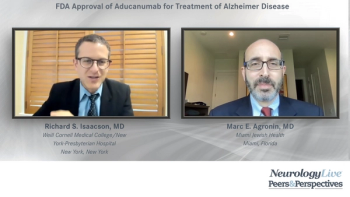
Expert neurologists, Richard S. Isaacson, MD, and Marc E. Agronin, MD, describe the journey to the FDA approval of aducanumab for the treatment of Alzheimer disease and what this means for clinicians.
The program director of the Medstar Georgetown University Hospital Headache Medicine Fellowship program discussed the potential of INP104 to improve migraine patient care.
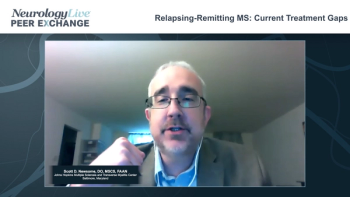
Gaps in care that neurologists experience when treating patients with relapsing-remitting multiple sclerosis and considerations for recommending lifestyle modifications to help manage symptoms.

The medical director of the Westport Headache Institute spoke to the role that devices can play in layered and variable treatment approaches, and how this better lends itself to offering personalized treatment to different individuals with migraine
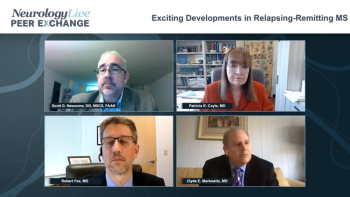
Exciting strategies and biomarkers being investigated to improve the evaluation and treatment of patients with relapsing-remitting multiple sclerosis.

The director of the Headache Center of Southern California shared his thoughts on the factors and barriers that go into conducting trials that treat patients with migraine with multiple drugs.

The director of the Sleep-Wake Disorders Center at Montefiore Medical Center discussed the formulaic background of FT218 and why it’s so effective in treating sleep disorders.

Neurology News Network for the week ending June 12, 2021.
The medical director of the Westport Headache Institute shared her insight into the use of the e-TNS device and the role of neuromodulation in migraine.
A discussion on having conversations with the parents of patients with Dravet syndrome with regards to adjustments to therapy and managing their expectations.
A panel of experts considers current unmet needs in SMA by emphasizing the need for further study of combination therapy, more comprehensive newborn screening, and more effective early diagnosis and treatment.
A panel of experts discuss treatment goals for patients with Dravet syndrome and how to convey the variability of treatment to the parents of these patients.
Key opinion leader in neurology Claudia Chiriboga, MD, MPH provides insight into response to risdiplam in patients with SMA who were not naïve to treatment as studied in the JEWELFISH clinical trial.
The nurse practitioner at the Woodruff School of Nursing at Emory University detailed why advanced practice clinicians should be utilized more in neurology settings.
The program director of the Medstar Georgetown University Hospital Headache Medicine Fellowship program discussed further research to be conducted with the nasal delivery of DHE.

The director for the Montefiore Headache Center discussed the COURAGE study and how to effectively use a layered treatment approach with ubrogepant and CGRP monoclonal antibodies.
Key opinion leaders in neurology, Lawrence Steinman, MD and Enrique Alvarez, MD, PhD, reflect on future developments in the management of multiple sclerosis and share key advice for community physicians.

Expert neurologists and epileptologists share best practices for transitioning a patient with TSC from adolescence into adulthood.
Final thoughts from leading experts on the future of treating Duchenne muscular dystrophy and keeping standard of care in the forefront.

Recent approval of casimersen, its administration, efficacy, safety, and patient selection for treatment of Duchenne muscular dystrophy.
Elizabeth Thiele, MD, PhD, and Peter Crino, MD, PhD, comment on unmet needs and challenges in treating tuberous sclerosis complex.

Thought leaders in neurology consider the role of BTK inhibitors such as evobrutinib and review the potential impact on patients with progressive multiple sclerosis.
The program director of the Medstar Georgetown University Hospital Headache Medicine Fellowship program discussed the advantages of INP104 over other forms of dihydroergotamine.

Ian Kremer, executive director of the LEAD Coalition, discusses the need for improved access to social services surrounding the diagnosis and management of Alzheimer disease.
The director of the Headache Center of Southern California provided insight on how a layered treatment approach to chronic migraine can be directly implemented into clinical care.

The director of the Montefiore Headache Center detailed the ways the Migraine Buddy app can help simplify conducting migraine clinical trials while expanding the reach of patients.