

Following the FDA approval of tividenofusp alfa, this piece explores the evolving Hunter syndrome treatment landscape and highlights key pipeline therapies targeting both systemic and CNS disease burden.
Following the FDA approval of tividenofusp alfa, this piece explores the evolving Hunter syndrome treatment landscape and highlights key pipeline therapies targeting both systemic and CNS disease burden.

Here's some of what is coming soon to NeurologyLive® this week.
Early clinical and real-world data suggest meningococcal vaccination is associated with a low risk of short-term relapse in patients with anti–aquaporin-4 antibody–positive NMOSD.
Test your neurology knowledge with NeurologyLive®'s weekly quiz series, featuring questions on a variety of clinical and historical neurology topics. This week's topic is ocular generalized myasthenia gravis!

A subpopulation analysis of the phase 2 ADHERE trial suggests clinical benefit and a favorable safety profile for efgartigimod PH20 in Chinese patients with chronic inflammatory demyelinating polyneuropathy.
Experts debate DEVO and MEVO interventions, exploring emerging approaches in stroke care, the role of advanced imaging, and how evolving evidence may shape treatment decisions. [WATCH TIME: 2 minutes]

Neurology News Network for the week ending April 4, 2026. [WATCH TIME: 5 minutes]
Members from Danaher Diagnostics provided clinical commentary and insights on an emerging immunoassay geared towards testing apolipoprotein (APOE) in patients with suspected Alzheimer disease.

Take 5 minutes to catch up on NeurologyLive®'s highlights from the week ending April 3, 2026.
Experts discuss the evolving philosophy of stroke care, highlighting the importance of rapid recognition, advanced imaging, and expanding treatment pathways for patients with suspected stroke. [WATCH TIME: 4 minutes]

An international real-world analysis highlighted prolonged time to diagnosis and common misdiagnoses in patients with chronic inflammatory demyelinating polyradiculoneuropathy.

Mind Moments®, a podcast from NeurologyLive®, brings you an exclusive interview with Sarah Hoffmann, MD, PhD. [LISTEN TIME: 15 minutes]

A neuroimmunology fellow at the Cleveland Clinic reflected on the 2026 ACTRIMS Forum, highlighting key takeaways in multiple sclerosis research presented in the program. [WATCH TIME: 6 minutes]

A recent retrospective cohort analysis suggests newer NMOSD-specific treatments may offer improved efficacy and safety compared with rituximab and commonly used off-label therapies.
Experts discuss how updated stroke guidelines introduce new considerations for pediatric stroke care, emphasizing improved recognition, specialized expertise, and collaboration between pediatric and adult stroke centers. [WATCH TIME: 5 minutes]
Catch up on any of the neurology headlines you may have missed in March 2026, compiled into 1 place by the NeurologyLive® team.

Nazem Atassi, MD, SVP and Global Development Head of Neurology & Gene Therapy at Novartis, discussed 64-week STEER data and the evolving role of one-time gene therapy in SMA care.

A case report of a 12-year-old boy highlighted a potential association between immunoglobulin G subclass imbalance and antibody detection in myelin oligodendrocyte glycoprotein antibody disease.

Peter Sguigna, MD, assistant professor of neurology at UT Southwestern Medical Center in Dallas, Texas, spoke on emerging research, innovative biomarkers, and expanding targeted therapies for patients living with NMOSD.
A cross-sectional study suggests excessive daytime sleepiness may represent an independent, nonmotor feature of idiopathic normal pressure hydrocephalus, separate from apnea or disease severity.
Constance V. Katsafanas, DO, director of the Neurology Residency Program at the Marcus Neuroscience Institute, highlighted the importance of individualized treatment strategies in multiple sclerosis.
Adults with Down syndrome face a high lifetime risk of early-onset Alzheimer disease linked to the triplication of chromosome 21, driving ongoing clinical investigations into targeted biomarkers and therapies for this population.

Rachele Berria, MD, PhD, Medical Affairs at Chiesi Global Rare Diseases, discussed the clinical data and implications of newly approved every-4-week dosing of pegunigalsidase alfa for Fabry disease in Europe.
BridgeBio Pharma has submitted a new drug application to the FDA for BBP-418 for the treatment of limb-girdle muscular dystrophy type 2I/R9, supported by interim phase 3 trial data.
The director of the Neurology Residency Program at the Marcus Neuroscience Institute detailed the importance of tailoring treatment to patients with multiple sclerosis. [WATCH TIME: 5 minutes]
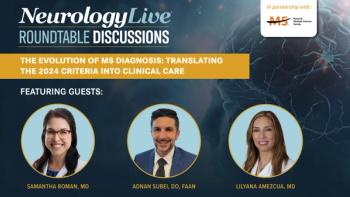
A group of neuroimmunologists discuss how the updated McDonald criteria will shape neurologist training and highlight key barriers to implementation, including imaging access, resource limitations, and knowledge dissemination.
The FDA has approved a higher-dose regimen of nusinersen for spinal muscular atrophy, supported by DEVOTE data showing improved motor outcomes, reduced neurodegeneration markers, and a safety profile consistent with prior dosing.
Here's some of what is coming soon to NeurologyLive® this week.
A new obstructive sleep apnea study suggested that fatigue and objective daytime sleepiness are uncorrelated, challenging the use of the Epworth Sleepiness Scale as a measure of sleepiness.
Panelists review emerging real-world and ECTRIMS data demonstrating that the updated McDonald criteria improve earlier MS diagnosis while maintaining diagnostic accuracy across diverse clinical settings.