Now Playing
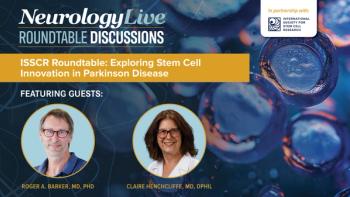
Neurologists Roger Barker, MBBS, MRCP, PhD, FMedSci, and Claire Henchcliffe, MD, DPhil, discuss the development, goals, and educational value of ISSCR's new stem cell medicine course for Parkinson disease.
Stem cell-based therapies continue to attract growing interest in Parkinson disease, with advances in regenerative medicine fueling new research, clinical trials, and patient questions. To help clinicians better understand this evolving area, the International Society for Stem Cell Research (ISSCR), in collaboration with Harvard Medical School, recently launched an educational course focused on stem cell medicine in Parkinson disease.
In this episode of NeurologyLive's Roundtable Discussion series, Roger Barker, MBBS, MRCP, PhD, FMedSci, professor of clinical neuroscience at the University of Cambridge, and Claire Henchcliffe, MD, DPhil, professor of neurology at the University of California, Irvine, discuss how the course was developed and the motivations behind its creation. The conversation explores why Parkinson disease has emerged as a leading area for stem cell research, the value of providing clinicians with accessible educational resources, and the importance of incorporating global perspectives and patient experiences into stem cell education.
Transcript edited for clarity.
Roger Barker, MD, PhD: So, I think probably the easiest way to think of this is: what does the International Society for Stem Cell Research do, which is actually where this originated? They have been a very active charity for many years. They've been trying to support stem cell research, and in the last 10 to 15 years, they've moved much more from basic science into the clinical side. They've been trying to look at the applications of stem cells in clinical practice, and Parkinson disease is a front runner in that because it's got a very clear pathology around a particular cell loss.
It's attracted a lot of attention in terms of cell replacement, so they thought this would be quite a good area in which to educate and update people on how stem cells are being used in Parkinson's. They reached out to myself here in the UK and Claire, who is from the UK but defected to the US, to talk about this. It's something they've set up with Harvard Medical School to create these educational modules and training programs, which is something quite new.
That's how it came about, and obviously the point of it is to have it as a rolling program, so there will be other diseases featured in the future. It's built on a background of a more basic understanding of stem cells more generally. Claire and I were asked to do this, and that's what we did. And it went well, didn't it, Claire?
Claire Henchcliffe, MD, DPhil: It was great. It's always fantastic to work with you, and I always learn a lot.
In terms of learning a lot, I just wanted to give my experience of this course. Although I've worked in Parkinson's for so many years and have had a very strong interest in the use of stem cell technologies to advance what we can do for people with Parkinson's, I'm less well grounded than you are, Roger, in terms of the bigger picture.
What I really enjoyed, in addition to our Parkinson's course, was the foundational course. I actually learned a lot. There were sections that I found incredibly helpful, especially the section on unproven therapies and how we can think about and communicate those issues. Like you, I was absolutely delighted that Parkinson's has been recognized as a front runner, along with diabetes, retinal disorders, and cancer.
The other thing that I really like about this is that, as the name implies, the ISSCR really takes great pains to include people from different parts of the world. Although Roger and I originated in the same place, we work in completely different medical environments. The way we're interacting with our patients and the resources we have available are really quite different. I think that international perspective was very important.
I also want to add one last point. I really loved that you brought in someone with lived experience of Parkinson disease. That made a world of difference to me in terms of hearing someone's own experience, not us talking about it, but someone who has actually been through one of these new and very innovative interventions.
Roger Barker, MD, PhD: That's a very good point about the international aspect because it can be a problem with societies to become a bit parochial and refer only to their local environment. Obviously, with this being US-based, there's a tendency to focus on the FDA and related issues, but actually it is very global.
A lot of what's included in the modules is more generic, foundational information, so it's not region-specific. I think they've had over 7,000 or 8,000 people complete the foundational stem cell course, and that's from all around the world. This has become something that anybody can tap into.
The other thing I found helpful is that it's useful to get other perspectives. In clinic, scarcely a week goes by without someone asking about this. The patient community is very important. Families are very informed and want to know about these therapies. Having somewhere they can turn for an up-to-date account and discussion about it is going to be very valuable for everybody.
Claire Henchcliffe, MD, DPhil: Agreed.