



MS and Demyelinating Disorders
Latest News
Advertisement
Latest Videos





CME Content






Advertisement
More News
Kristen Krysko, MD, summarizes the results of the phase III ORATORIO trial and discusses the rationale for using ocrelizumab for the treatment of progressive multiple sclerosis.

The senior director of patient management, care, and rehabilitation research at the National MS Society discussed the lack of studies on progressive MS compared to RRMS.

Researchers found significant differences between clinically relevant areas in participants with progressive MS, relapsing MS, and healthy controls.

Stephanie Blandford, MSc, a PhD candidate at Memorial University of Newfoundland, discussed some advantages of using IL-1RA over NfL in predicting disability in multiple sclerosis.
The PhD candidate at the Barts MS Center in London discussed the upcoming Chariot MS study as well as further research she would like to conduct in personalized cladribine dosing.
Expert neurologist Lauren B. Krupp, MD provides insight into the use of diagnostic tools for pediatric multiple sclerosis such as MRI imaging, laboratory blood tests, and lumbar punctures.
Key opinion leaders in the management of MS comment on the current diagnostic criteria and discuss the importance of ruling out other common mimics in pediatric patients.

Alise Carlson, MD, a resident at Cleveland Clinic, provided insight on how raising awareness for genetic leukodystrophies may ultimately improve misdiagnosis rates.
A patient, Richard, discusses his positive experience with multiple sclerosis virtual visits during COVID-19.
Mary Ann Picone, MD, describes the incorporation of televisits for multiple sclerosis during COVID-19.

Here's what is coming soon to NeurologyLive.

Neurology News Network for the week ending April 3, 2021.

A series of video modules aims to address the unique challenges faced by nursing professionals caring for patients with MS in rural areas.
Take 5 minutes to catch up on NeurologyLive's highlights from the week ending April 2, 2021.
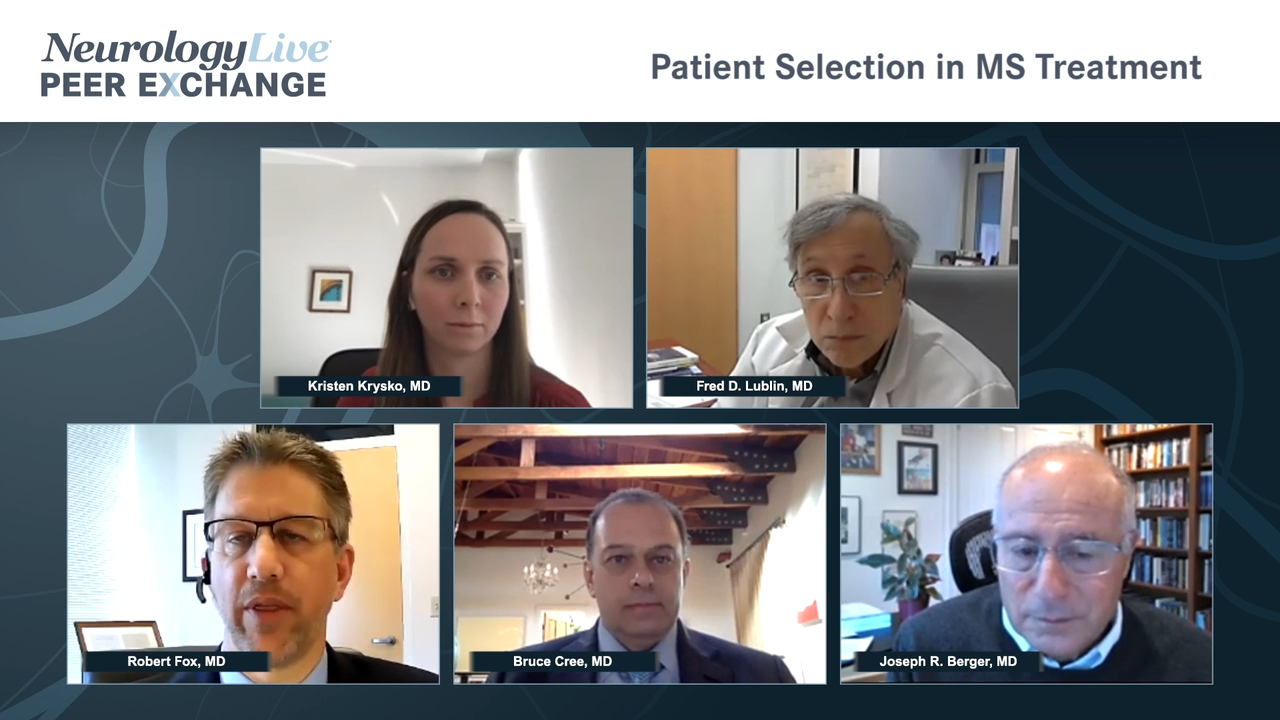
Experts in the field of multiple sclerosis compare the results of the EXPAND study to the results of the ASCEND study.
Robert Fox, MD, discusses the rationale for using siponimod for the treatment of progressive multiple sclerosis as well as the practical implications of the phase 3 EXPAND trial.

The duo from the National Institutes of Health discussed the advantages of the ultra-high resolution imaging technology in research.

Progressive forms of multiple sclerosis present a number of challenges for MS specialists, the biggest of which being whether or not disease-modifying therapy is required.

The postdoctoral researcher at Columbia University discussed the long-term plans to gain a better understanding of MS diagnosis disclosure and how it can impact other qualities of life.
The fellow of autoimmune neurology at Massachusetts General Hospital also discussed concerns of associations between multiple sclerosis and COVID-19.
Lauren B. Krupp, MD provides insight into the signs and symptoms of multiple sclerosis and emphasizes differences in clinical presentation between adult and pediatric patients.

Thought leaders in neurology discuss the results of the phase 3 PARADIGMS trial as well as the safety and efficacy of fingolimod for use in pediatric patients with multiple sclerosis.

Tanuja Chitnis, MD provides an overview of genetic, environmental, and hormonal risk factors for pediatric multiple sclerosis and discusses its prevalence based on age, sex, and geographic location.

Patients treated with NurOwn showed a mean improvement from baseline of 10% in timed 25-foot walk and a 4.9% improvement from baseline on the 9-hole peg test dominant hand.
The PhD candidate at the Barts MS Center in London discussed her study presented at ACTRIMS Forum 2021 that evaluated CPD in patients with relapsing MS.
Advertisement
Advertisement
Trending on NeurologyLive - Clinical Neurology News and Neurology Expert Insights
1
uniQure Submits BLA for Gene Therapy in HD, AAN, AHS Issue Updated Guideline on Migraine Prevention, CTE Prevalence, Brain Donation Findings in Former NFL Players
2
American Academy of Neurology, American Headache Society Issue Updated Guideline on Migraine Prevention
3
uniQure Submits BLA for Gene Therapy in Huntington Disease
4
FDA Approves Zilganersen, First Treatment for Alexander Disease
5