



MS and Demyelinating Disorders
Latest News
Advertisement
Latest Videos




CME Content






Advertisement
More News
The professor of neurology and director of the Buffalo Neuroimaging Analysis Center discussed the background of the ORATORIO study and the aT2-LV biomarker.
The senior director of patient management, care, and rehabilitation research at the National Multiple Sclerosis Society discussed the importance of fundraising events to further MS research.
The professor of neurology and director of the Buffalo Neuroimaging Analysis Center discussed his work on the ORATORIO study.
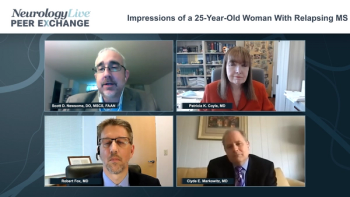
Clyde E. Markowitz, MD, reacts to how he would manage a 25-year-old woman who presents with 2 weeks of progressive left-sided monocular vision loss and pain with eye movement, but reports no other symptoms or significant history.
Important considerations regarding the use of anti-CD20 therapies such as ofatumumab to treat relapsing multiple sclerosis during the COVID-19 pandemic and strategies that can help neurologists talk with patients about drug use and COVID-19 vaccinations.

Here's what is coming soon to NeurologyLive.

The trial will be the first neuroimaging study aimed at observing the impacts of rhythmic auditory stimulation on walking impairment in multiple sclerosis.
The Ralph and Luci Schey Chair and Director of the Schey Center for Cognitive Neuroimaging at Cleveland Clinic discussed his investigations into improving the MSPT.
Neurology News Network for the week ending May 22, 2021.
The senior director of patient management, care, and rehabilitation research at the National MS Society discussed the organization’s ultimate goal of curing MS.
Take 5 minutes to catch up on NeurologyLive's highlights from the week ending May 21, 2021.

Environmental factors such as smoking, alcohol consumption, overweight/obese status, and sun exposure were associated with an increased risk of relapsing-onset and progressive-onset MS.
The Ralph and Luci Schey Chair and Director of the Schey Center for Cognitive Neuroimaging at Cleveland Clinic discussed the importance of correcting practice effects to determine performance.

Only 4.9% of respondents in active clinical practice at the time of the survey reported not using telehealth when providing patient care services.
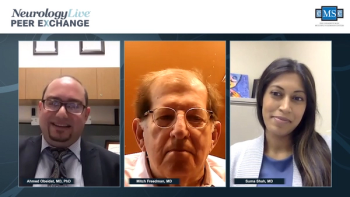
Join Ahmed Obeidat, MD, PhD; Mitchell Freedman, MD; and Suma Shah, MD, for the second program of this monthly series as they discuss the evolution of therapeutics for the treatment of multiple sclerosis.
The professor of neurology and director of the Buffalo Neuroimaging Analysis Center discussed the development of the aT2-LV biomarker.
The senior director of patient management, care, and rehabilitation research at the National MS Society discussed challenges in care and rehabilitation in patients with progressive MS.
The rationale for treating patients with relapsing multiple sclerosis with ofatumumab based on data revealed by the ASCLEPIOS I and ASCLEPIOS II trials.
Implications for initiating treatment with a high-efficacy therapy for a 35-year-old man who presents with progressive numbness and weakness in his left arm and leg.

Robert Fox, MD, Vice-Chair for Research at the Cleveland Clinic Neurological Institute, discussed the findings of the phase 2 EMPhASIS trial of this investigational MS therapy.
Here's what is coming soon to NeurologyLive.
The Ralph and Luci Schey Chair and Director of the Schey Center for Cognitive Neuroimaging at Cleveland Clinic discussed populations that exhibit greater practice effects than others.
Neurology News Network for the week ending May 15, 2021.
Take 5 minutes to catch up on NeurologyLive's highlights from the week ending May 14, 2021.
The neurologist from Cleveland Clinic stressed the potential for responsive neurostimulation in older populations with epilepsy and the need for expanded research.
Advertisement
Advertisement
Trending on NeurologyLive - Clinical Neurology News and Neurology Expert Insights
1
uniQure Submits BLA for Gene Therapy in HD, AAN, AHS Issue Updated Guideline on Migraine Prevention, CTE Prevalence, Brain Donation Findings in Former NFL Players
2
American Academy of Neurology, American Headache Society Issue Updated Guideline on Migraine Prevention
3
uniQure Submits BLA for Gene Therapy in Huntington Disease
4
FDA Approves Zilganersen, First Treatment for Alexander Disease
5