
Experts discuss how updated stroke guidelines introduce new considerations for pediatric stroke care, emphasizing improved recognition, specialized expertise, and collaboration between pediatric and adult stroke centers. [WATCH TIME: 5 minutes]
Experts discuss how updated stroke guidelines introduce new considerations for pediatric stroke care, emphasizing improved recognition, specialized expertise, and collaboration between pediatric and adult stroke centers. [WATCH TIME: 5 minutes]
A forward-looking discussion on how real-world experience is shaping the use of ublituximab, including patient selection, infusion logistics, monitoring strategies, and emerging considerations such as subcutaneous development and long-term safety management.
A comprehensive review of long-term safety findings with ublituximab, including infection risk, immunoglobulin trends, and tolerability over 5 years, with context on how these data inform ongoing treatment decisions in relapsing MS.
An in-depth analysis of 5-year ULTIMATE open-label extension data, highlighting sustained relapse reduction, disability outcomes, and the long-term impact of early ublituximab initiation in relapsing MS.
In 'Navigating Diagnostic Challenges in Narcolepsy,' our panel delves into the practical challenges of diagnosing narcolepsy in clinical settings, opening with a discussion of supplementary tools such as actigraphy, sleep diaries, and standardized scales including the Pittsburgh Sleep Quality Index.
In this episode, 'Narcolepsy Comorbidities, Quality of Life, and Risk Factors', the experts explore the far-reaching impact of narcolepsy beyond sleepiness, examining how sleep-wake instability undermines the ability to reliably show up for work, school, and relationships, often resulting in incomplete education, job loss, and chronic feelings of inadequacy. The persistence of sleepiness, unlike the restorative relief healthy individuals experience after rest, distinguishes narcolepsy as a fundamentally different and more burdensome condition.
Neuroimmunologist Bruce Cree, MD, provides a detailed overview of ublituximab as an anti-CD20 therapy, including its mechanism of B-cell depletion, differentiation from other agents in the class, and the clinical trial pathway that led to its approval in relapsing MS.
The professor of neurology at Mayo Clinic spoke about the current state of biomarker research in MSA. [WATCH TIME: 8 minutes]
The director of the Neurology Residency Program at the Marcus Neuroscience Institute detailed the importance of tailoring treatment to patients with multiple sclerosis. [WATCH TIME: 5 minutes]
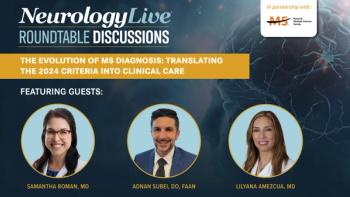
A group of neuroimmunologists discuss how the updated McDonald criteria will shape neurologist training and highlight key barriers to implementation, including imaging access, resource limitations, and knowledge dissemination.
Panelists review emerging real-world and ECTRIMS data demonstrating that the updated McDonald criteria improve earlier MS diagnosis while maintaining diagnostic accuracy across diverse clinical settings.
Experts discuss how the updated McDonald criteria redefine radiologically isolated syndrome and explore the clinical, imaging, and access challenges of diagnosing and treating MS before symptom onset.
Neurology News Network for the week ending March 28, 2026. [WATCH TIME: 4 minutes]

Experts discuss the optimistic future of MS treatment, emphasizing early diagnosis, consistent care, and a partnership approach for improved patient outcomes.
A panel of MS experts breaks down the most impactful updates to the 2024 McDonald criteria, highlighting how new biomarkers, imaging features, and diagnostic flexibility are reshaping earlier and more accurate MS diagnosis.
Healthcare professionals discuss setting realistic long-term goals for MS patients, emphasizing the importance of early treatment and patient education.

Raj Rajaraman, MD, MS, discussed the clinical and genetic distinctions of CDKL5 deficiency disorder, emphasizing its early onset, unique seizure patterns, and differentiation from related syndromes.
Raj Rajaraman, MD, MS, discussed early clinical indicators of CDKL5 deficiency disorder and emphasized the importance of timely, comprehensive genetic testing strategies.
In this final episode, the panel looks ahead to the next phase of NMOSD research—calling for standardized relapse definitions, prospective comparative trials, improved acute treatment strategies, and more selective immune-targeted therapies that move beyond broad immunosuppression.
The founder and CEO at the Hereditary Neuropathy Foundation discussed how learning about patient experiences has influenced research in Charcot-Marie-Tooth disease. [WATCH TIME: 5 minutes]
This episode, titled 'Identifying Narcolepsy in Psychiatric Populations,' features panelists discussing the challenges of recognizing narcolepsy in psychiatric populations, where overlapping symptoms of mood dysregulation, fatigue, and attention difficulties can easily redirect clinical attention away from an underlying sleep disorder.
In 'Reviewing the Prevalence and Underdiagnosis of Narcolepsy,' our panel delves into the prevalence and underdiagnosis of narcolepsy, pushing back against the widespread assumption that it is a rare condition.

The 2026 MDA National Ambassador discussed the importance of connecting patients’ experiences with scientific understanding, as well as fostering a sense of community among those living with neuromuscular disease. [WATCH TIME: 2 minutes]
The division chief of neuroimmunology at Brigham and Women’s Hospital provided clinical insights on a recently published study in JAMA Neurology covering EBNA-1 antibodies as a diagnostic clue in neuroinflammatory diseases like multiple sclerosis. [WATCH TIME: 4 minutes]
Experts weigh factor XIa inhibitor asundexian after ischemic stroke, highlighting strong efficacy and safety signals and fueling optimism for Librexia Stroke trial results.
Global trial tests ascendexian after ischemic stroke/TIA, showing low bleeding and raising questions about diversity and real-world fit.

The chief research officer of the Muscular Dystrophy Association spoke on highlights and themes from the organization's 2026 Clinical and Scientific Conference. [WATCH TIME: 9 minutes]
In episode 1, neurologist Catherine Lomen-Hoerth, MD, PhD, is joined by Timothy Miller, MD, PhD, to discuss pivotal long-term data showing tofersen's meaningful impact in patients with SOD1 ALS.

Neurology News Network for the week ending March 21, 2026. [WATCH TIME: 4 minutes]
Healthcare professionals emphasize the importance of partnership in MS treatment, focusing on personalized goals and empowering patients to take control of their health.