



NMOSD
Latest News
Advertisement
Latest Videos


CME Content












Advertisement
More News

Most attacks occurred within the first year of inebilizumab treatment, and nearly all participants were attack free in subsequent years following treatment initiation.

The neurologist at Wayne State University School of Medicine discussed recently published data describing inebilizumab’s role in producing rapid and sustained B-cell depletion in African Americans with NMOSD [WATCH TIME: 4 minutes]
What to know about treating patients with neuromyelitis optica spectrum disorders throughout the COVID-19 pandemic.
An overview of newer preventive therapies approved for acute attacks of neuromyelitis optica spectrum disorders, and variables that impact treatment selection.

The study is the first to provide data from all Latin American countries, further identifying geographic-resultant limitations of access to technology and therapy for NMOSD.
Types of testing that can help neurologists distinguish between acute attacks of neuromyelitis optica spectrum disorders (NMOSD) and multiple sclerosis, as well as therapies that can be used to help manage patients with NMOSD.
Jacinta M. Behne, MA, describes how the Guthy-Jackson Charitable Foundation supports patients with neuromyelitis optica spectrum disorders.

Between PREVENT baseline and end, mean EDSS and Hauser Ambulation Index scores improved with eculizumab (Soliris; Alexion) monotherapy and deteriorated with placebo alone.

The findings identified Th2-related cytokines as characterizing for the prognosis of acute episodes of NMOSD at 1 month and found serum NfL to be a likely biomarker of disease severity at attack.
More than 80% of those with NMOSD experienced disease relapse 6 months after discontinuation of immunosuppressive therapy.
Doug and Kim, patients with neuromyelitis optica spectrum disorders, describe the types of symptoms that prompted each of them to seek an evaluation by a neurologist for an eventual diagnosis of a neuromyelitis optica spectrum disorder.
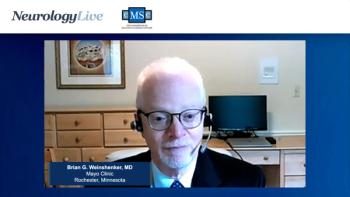
Mayo Clinic’s Brian G. Weinshenker, MD, compares multiple sclerosis with neuromyelitis optica spectrum disorders (NMOSD) and explains why community neurologists need to receive more education on NMOSD risk factors and symptoms.
Get the latest news in neuromyelitis optica spectrum disorder, with data updates and expert insights, all in one place from the NeurologyLive team.

The registry aims to enroll approximately 800 patients with NMOSD to evaluate the efficacy of new medications and treatments.

The director of the Mayo Clinic Center for Multiple Sclerosis and Autoimmune Neurology discussed unmet needs of care for patients with neuromyelitis optica spectrum disorder.

The neuro-ophthalmologist at UT Southwestern further discussed the high cost of treatment for patients with neuromyelitis optica spectrum disorder and the need to improve access to care.
The neuro-ophthalmologist at UT Southwestern Medical Center discussed optical coherence tomography and antibody detection technology used to diagnose optic neuritis associated with NMOSD.
The director of Mayo Clinic Center for Multiple Sclerosis and Autoimmune Neurology provided context on challenges within the NMOSD space and what’s next following the first-approved therapies.
Discussing NMOSD’s relation to AQP4 and pattern enhancement on MRIs, the neuro-ophthalmologist at UT Southwestern Medical Center further commented on the importance of early diagnosis.

Bruce Cree, MD, PhD, clinical research director of the UCSF Multiple Sclerosis Center, provided context on the status of patient education efforts and clinical development for neuromyelitis optica spectrum disorder.

The neuro-ophthalmologist from UT Southwestern Medical Center provided her opinion on the state of care for patients with NMOSD and associated optic neuritis technology.
The director of Mayo Clinic Center for Multiple Sclerosis and Autoimmune Neurology discussed the most notable recent advances that has propelled care for patients with NMOSD.

The clinical research director of the UCSF Multiple Sclerosis Center shared his perspective on the history of clinical care for neuromyelitis optica spectrum disorder in light of 3 recent FDA approvals.
Investigators found that frequency of MOG-Ab associated NMOSD was not significantly different between Asian and Caucasian populations despite the prevalence of NMOSD in Asian regions.

Lesions in the canalicular and intracranial optic nerve, area postrema, medulla, and cervical spinal cord were prominent in patients with aquaporin-4–NMOSD.
Advertisement
Advertisement
Trending on NeurologyLive - Clinical Neurology News and Neurology Expert Insights
1
First-in-Human Trial Begins for an Antisense Oligonucleotide in KCNT1-Related Epilepsy
2
Ocrelizumab Shows MRI Benefits vs Fingolimod in Phase 3 Pediatric-Onset Multiple Sclerosis Study
3
Clene Submits NDA Seeking Accelerated Approval for ALS Drug
4
RGX-202 Meets Primary End Point in Phase 3 Duchenne Trial
5