



Sleep Disorders
Latest News
Advertisement
Latest Videos



CME Content






Advertisement
More News
Experts in sleep medicine share emerging treatments in the pipeline for the management of sleep disorders.

Fan Nils Yang, PhD, postdoctoral researcher, University of Maryland, provides greater detail on the observational cohort study he did with colleagues, where they identified a link between neurocognitive function in children and insomnia.
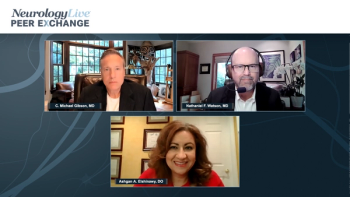
Drs C. Michael Gibson, Ashgan A. Elshinawy, and Nathaniel F. Watson examine setting treatment expectations with patients and treatment adherence for sleep disorders.
Ashgan A. Elshinawy, DO, shares her approach to treatment selection of DORAs and switching therapies for the management of sleep disorders.

Here's some of what is coming soon to NeurologyLive® this week.
Test your neurology knowledge with NeurologyLive®'s weekly quiz series, featuring questions on a variety of clinical and historical neurology topics. This week's topic is the history of the European Committee for Treatment and Research in Multiple Sclerosis.
Take 5 minutes to catch up on NeurologyLive®'s highlights from the week ending October 21, 2022.
Nathaniel F. Watson, MD, highlights the use of daridorexant for treating patients with insomnia as seen from phase 3 trials and data presented at the World Sleep 2022 meeting and managing adverse events.
Drs Ashgan A. Elshinawy, C. Michael Gibson, and Nathaniel F. Watson discuss FDA-approved medications currently used for the treatment of sleep disorders and insomnia, and comment on the difference between DORAs.

Based on a trial that showed melatonin improved total sleep time in children with ADHD and sleep onset insomnia, Colonis’ Melatonin 1mg/ml Oral Solution was approved by the MHRA in the United Kingdom.

When asked which efficacious diagnostic or treatment options they hope to see in the future, a majority of physicians, especially specialists, expressed a desire to see more useful biomarkers, followed by more effective diagnostic tests overall.

In a propensity score matched, longitudinal, observational cohort study, findings showed that there was an association between insomnia and neurocognitive function in children.
Nathaniel F. Watson, MD, reviews the pathways involved in sleep and wakefulness cycles as it relates to sleep disorders.
Dr Ashgan A. Elshinawy and C. Michael Gibson considers safety and efficacy factors when approaching treatment selection for sleep disorders and insomnia.
Ashgan A. Elshinawy, DO, comments on engaging patients in conversations around managing sleep disorders with co-occurring health conditions.
Experts in sleep medicine stress the importance of early diagnosis of sleep disorders and how they approach treatment in their clinics.
Here's some of what is coming soon to NeurologyLive® this week.
Test your neurology knowledge with NeurologyLive®'s weekly quiz series, featuring questions on a variety of clinical and historical neurology topics. This week's topic is Alzheimer disease and dementia.
Dr Nathaniel F. Watson reviews screening patients for sleep disorders and referral to sleep specialists.
Nathaniel F. Watson, MD; Ashgan A. Elshinawy, DO; and C. Michael Gibson, MD, examine complications patients encounter with sleep disorders, including for insomnia, and the impact on their quality of life.
Take 5 minutes to catch up on NeurologyLive®'s highlights from the week ending October 14, 2022.

A study conducted via telemonitoring showed that hospital workers who performed night shifts had significant negative impacts on their sleep quality and circadian rhythms.

The odds of having memory worsening at follow-up after 3 years were almost 30% greater for those who exhibited deteriorating insomnia status than those who showed signs of improvement.
Data from a systemic review suggests that the COVID-19 pandemic is associated with increased rates of subthreshold insomnia symptoms, but not with moderate or severe insomnia, among the global population.
Ashgan A. Elshinawy, DO, leads a discussion on the co-occurrence and relationship between sleep disorders and different health conditions in patients.
Advertisement
Advertisement
Trending on NeurologyLive - Clinical Neurology News and Neurology Expert Insights
1
FDA Approves Tavapadon for the Treatment of Parkinson Disease
2
2026 Rachel Horne Prize Winner Sandra Vukusic, MD, PhD, on Advancing Women's Health in MS
3
FDA Accepts Fenebrutinib NDA Under Priority Review for Relapsing and Primary Progressive MS
4
Phase 4 Study Evaluates Transition From IVIG to Subcutaneous Efgartigimod in CIDP
5